
AI and Robotics BSc (Hons)
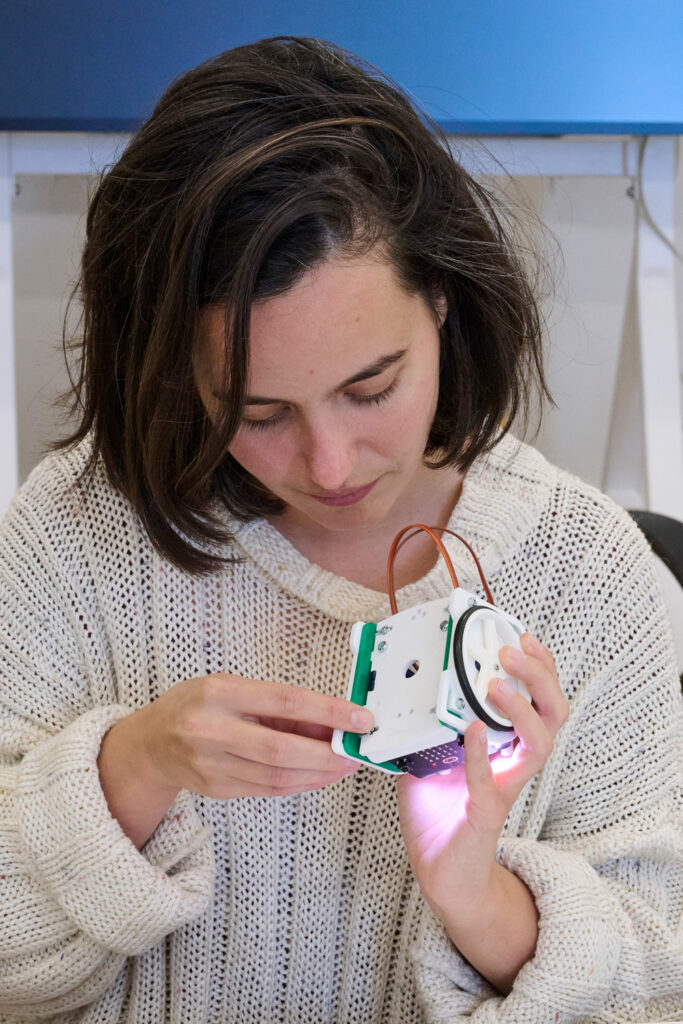
Design, build and program intelligent systems that perceive their surroundings, make informed decisions, and act autonomously in the real-world environments.
Key course information
Jointly awarded
-
Course Duration
3 or 4 Year options
-
Typical Offer
104-120 UCAS Tariff Points
-
Annual Fees
- Home (full-time) £10,050
- Overseas (full-time) £28,500
- How to Apply Request a prospectus
-
Course Start
September 2027
Two creative specialists. One future-defining partnership.
From September 2027, new undergraduate degrees at Norwich University of the Arts will be jointly awarded by Norwich and the Royal College of Art. Find out more about the partnership.
Our BSc AI and Robotics has been developed in response to rapid growth in industries built on artificial intelligence, automation and embodied intelligent systems. The course equips you with the technical, creative and analytical skills needed to design intelligent solutions that operate across physical and digital environments.
You’ll explore how intelligent machines sense and perceive their environments, make decisions, and act autonomously. Through hands‑on project work, you’ll learn to combine software, hardware and AI to create autonomous, interactive and intelligent systems that respond to real‑world constraints and human needs.
The course introduces you to the foundations of computer science before taking you deeper into artificial intelligence, robotics, automation and intelligent systems. From programming intelligent agents to developing autonomous and interactive technologies, you’ll gain practical experience aligned with employer demand in fast‑growing sectors such as AI engineering, robotics, automation, smart systems and applied research.
As you progress, you’ll develop a rigorous understanding of essential computing concepts alongside practical expertise in areas including machine learning, intelligent control, computer vision and networked systems. Each project is designed to strengthen your problem‑solving abilities and deepen your understanding of how intelligent systems process data, make decisions and interact with the world.
You’ll experiment with programming languages such as Python, C++ and Java, while working with AI frameworks, robotics platforms, sensors and physical computing systems. Alongside this, you’ll explore databases, networking and cloud‑based technologies, developing intelligent, real‑time and autonomous applications. As your confidence grows, you’ll tackle more advanced challenges including sensor fusion, robotics control systems and real‑time performance. Your learning journey is scaffolded with hands‑on project work, ensuring you graduate with experience of applying AI and robotics concepts in realistic contexts.
A key feature of the course is its balance between collaborative and independent work. Team‑based projects reflect industry workflows and help you develop communication, collaboration and technical leadership skills. In your final year, you’ll complete an individual, problem‑based project, designing and implementing an AI or robotics solution shaped by your interests and career ambitions.
Throughout the degree, you’ll engage with rapidly evolving areas of technology alongside critical discussions around ethics, sustainability and the societal impact of intelligent systems. With excellent tutorial support and interactive teaching, you’ll graduate confident, capable and ready for your future career or study.
2026 entry
If you’re thinking of applying to us through Clearing in 2026, please get in touch.
Email admissions@norwichuni.ac.uk or call us on +44 (0) 1603 751485.

Why study with us
-
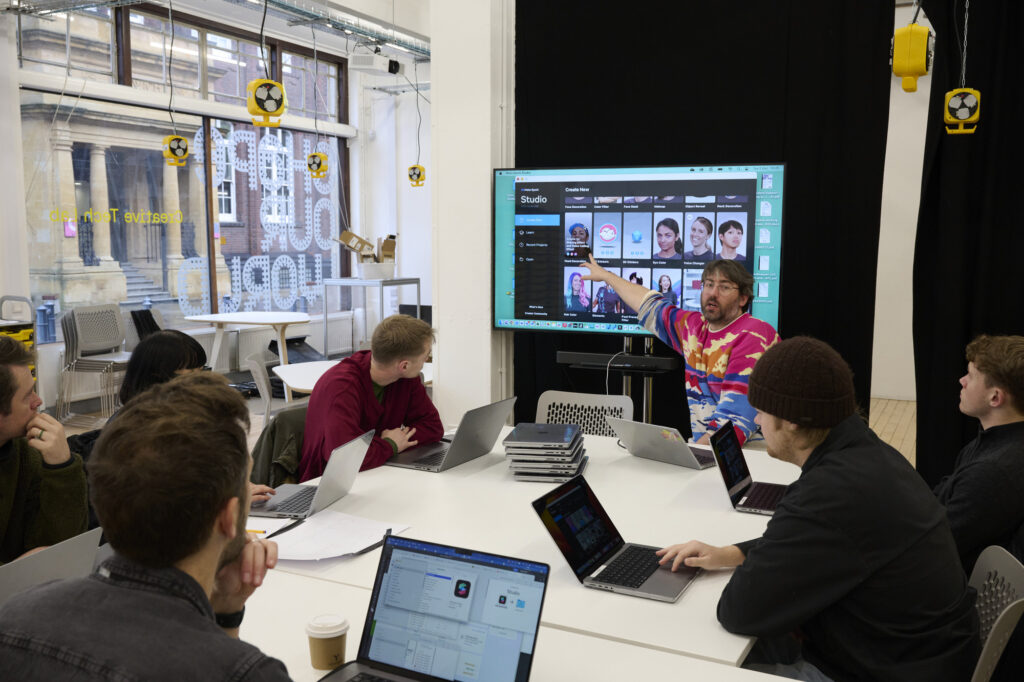
Benefit from well-resourced digital creative teaching facilities including a dedicated Creative Tech Lab and brand new Immersive Visualisation and Simulation Lab.
-
Develop core skills through project work with VR and AR, physical computing, projection mapping, lidar scanning, audio-visual composition, creative mechanics, and robotics.
-
Explore systems engineering alongside interaction design, learning how to make products fit for purpose.
-
Be introduced to machine learning, to add another dimension to your project work and build commercially sought after skills.
-
Develop advanced engineering and product development skills that are truly transferrable.
-
Develop team working skills and create amazing outcomes by collaborating with students from other disciplines.
-
Engage with a range of contemporary topics such as AI ethics, digital sustainability, digital culture and tech for good.
1 / 7
Course Details
Year 1
(Shared year with BSc Computer Science)
Core Units
Introduction to Studying AI and Robotics (40 credits)
This unit introduces core concepts of computer science, including computational thinking, programming fundamentals, and the role of computing in society. Students work with Python and C++ alongside essential mathematical foundations relevant to computing, while exploring historical, cultural, and societal impacts of computing.
40 credits
Research Methods in AI and Robotics (40 credits)
This unit introduces key research methodologies in computing, preparing you for advanced study and professional challenges in the field of AI and Robotics. It will develop your critical thinking, practical research skills, and ethical awareness. Real-world applications are explored through case studies, design simulations, and problem-based learning, allowing students to apply theoretical concepts to tangible issues. Technical learning includes web programming, building websites, and designing interfaces and interactions using HTML 5, CSS, and JavaScript.
40 credits
Concepts, Theories, and Practice in AI and Robotics (40 credits)
This unit introduces contemporary computing concepts including data security, trust, and networked environments. Students gain hands on experience with secure network design, encryption, penetration testing, and full stack development using SQL and NoSQL databases. You will gain hands-on experience in data analysis for detecting security anomalies and understanding attack patterns, as well as ethical considerations around hacking tools and user privacy.
40 credits
Core Projects
Wayfinding Week
The first week of each academic year is called Wayfinding week. It’s an opportunity get your bearings, establish new connections and, after your first year at Norwich, re-establish old ones. Your course team will talk you through the year ahead and explain the expectations for the year. We’ll help you navigate new encounters and identify areas to focus on as you progress through your course.
Make it Manifest(o)
An important element of Wayfinding Week is taking part in our annual ‘Make it Manifest(o)’ project. Your course team will introduce the project in which we’ll ask you to consider your hopes and vision of the year ahead at Norwich and work with students in other year groups to bring your ideas to life. The project culminates in a celebratory display of work across the campus. The project will help you to develop your critical creativity through different approaches, concepts, and mediums. You’ll encounter diverse perspectives and build friendships and networks within our university community.
Interchange Week
Interchange weeks are opportunities to step away from your disciplinary studies and engage in projects, workshops, visits and talks that extend your knowledge and understanding of the world. Whether you learn a new skill or take part in a global challenge project with students from other courses, you will come away with new insights to take back to your course. Interchange is part of the schedule for all Norwich students with sessions held across and beyond the campus led by university staff, visiting lecturers and students.
Year 2
Core Units
Models, methods and practice in AI and Robotics (40 credits)
This unit introduces core artificial intelligence techniques underpinning intelligent systems. Students explore supervised and unsupervised machine learning, neural networks, reinforcement learning, and intelligent agents. Practical work focuses on implementing AI models using real or simulated data, evaluating performance, and embedding learning systems into interactive applications.
40 credits
Global Citizenship and Perspectives in AI and Robotics (40 credits)
This unit explores the ethical, social, and global challenges with AI and Robotics, encouraging you to critically assess the implications of internationalization, localization, and the technical impact on sustainability. Students work with robotic platforms, sensors, and actuators to design autonomous systems capable of perception, movement, and interaction. Topics include kinematics, control systems, sensor fusion, robot operating systems, and autonomous navigation in real world and simulated environments.
40 credits
Collaborative Development for AI and Robotics (40 credits)
Students develop professional practice in the collaborative design and development of AI and robotic systems. Working in interdisciplinary teams, they apply software engineering principles, version control, while pursuing rapid prototyping. Through workshops and seminars, you’ll develop skills in identifying productive collaborators, understanding audience and context, and applying effective ideation and problem-solving methodologies. Team projects reflect industrial workflows and focus on solving real world robotics or AI challenges.
40 credits
Core Projects
Wayfinding Week
The first week of each academic year is called Wayfinding week. It’s an opportunity get your bearings, establish new connections and, after your first year at Norwich, re-establish old ones. Your course team will talk you through the year ahead and explain the expectations for the year. We’ll help you navigate new encounters and identify areas to focus on as you progress through your course.
Make it Manifest(o)
An important element of Wayfinding Week is taking part in our annual ‘Make it Manifest(o)’ project. Your course team will introduce the project in which we’ll ask you to consider your hopes and vision of the year ahead at Norwich and work with students in other year groups to bring your ideas to life. The project culminates in a celebratory display of work across the campus. The project will help you to develop your critical creativity through different approaches, concepts, and mediums. You’ll encounter diverse perspectives and build friendships and networks within our university community.
Interchange Week
Interchange weeks are opportunities to step away from your disciplinary studies and engage in projects, workshops, visits and talks that extend your knowledge and understanding of the world. Whether you learn a new skill or take part in a global challenge project with students from other courses, you will come away with new insights to take back to your course. Interchange is part of the schedule for all Norwich students with sessions held across and beyond the campus led by university staff, visiting lecturers and students.
Diploma Year (optional)
Level 5 Diploma (120 credits)
Students have the opportunity to spend a year after the second of their degree (or the third year if studying for a degree with an Integrated Foundation Year) enhancing their employability options through a Level 5 Diploma in Creative Professional Development. This course is designed to provide opportunities to gain industry insight, developing employability skills through a series of supported experiences, expanding professional networks and building confidence in the workplace.
Find out more about our Level 5 Diploma in Creative Professional Development.
Year 3
Core Units
Professional Practice in AI and Robotics (40 credits)
This unit prepares students for professional and industrial contexts in AI and robotics. Topics include responsible AI, safety critical systems, cybersecurity for autonomous systems, and system deployment using cloud and edge platforms. Students explore career pathways such as AI Engineer, Robotics Developer, Automation Specialist and Research Engineer, alongside entrepreneurship, start up culture, and postgraduate study options.
40 credits
Advanced research and project design for AI and Robotics (40 credits)
Students explore advanced topics such as computer vision, real time AI systems, intelligent control, human robot interaction, and embodied cognition. The unit integrates research methods, ethical frameworks, and emerging debates around autonomy, bias, accountability, and post humanism. Students also develop a formal research proposal in preparation for the major project.
40 credits
Major Project in AI and Robotics (40 credits)
Your major project is a chance to combine the knowledge and skills you have gained throughout your degree. The major project is an individual, self directed piece of work that brings together learning from across the degree. Students design, implement, and evaluate a substantial AI or robotics system, supported by regular academic supervision. Projects may focus on autonomous robots, intelligent agents, vision based systems, creative robotics, or applied AI solutions aligned to career aspirations.
40 credits
Core Projects
Wayfinding Week
The first week of each academic year is called Wayfinding week. It’s an opportunity get your bearings, establish new connections and, after your first year at Norwich, re-establish old ones. Your course team will talk you through the year ahead and explain the expectations for the year. We’ll help you navigate new encounters and identify areas to focus on as you progress through your course.
Make it Manifest(o)
An important element of Wayfinding Week is taking part in our annual ‘Make it Manifest(o)’ project. Your course team will introduce the project in which we’ll ask you to consider your hopes and vision of the year ahead at Norwich and work with students in other year groups to bring your ideas to life. The project culminates in a celebratory display of work across the campus. The project will help you to develop your critical creativity through different approaches, concepts, and mediums. You’ll encounter diverse perspectives and build friendships and networks within our university community.
Interchange Week
Interchange weeks are opportunities to step away from your disciplinary studies and engage in projects, workshops, visits and talks that extend your knowledge and understanding of the world. Whether you learn a new skill or take part in a global challenge project with students from other courses, you will come away with new insights to take back to your course. Interchange is part of the schedule for all Norwich students with sessions held across and beyond the campus led by university staff, visiting lecturers and students.
Download course specifications
AI and Robotics BSc Hons 3 Year Degree Course Specification – (290kb)
Download PDFAI and Robotics BSc Hons 3 Year Degree Course Specification
(opens in a new window)
Learning and teaching
This course is taught through a mixture of learning and teaching methods including:
-
Group briefings
-
Academic tutorials
-
Group tutorials
-
Workshops
-
Critiques (crits)
-
Seminars
-
Lectures
1 / 7
Assessment
Assessment for this course is entirely coursework-based, meaning there are no exams. Your progress will be evaluated through the projects and assignments you complete for each unit. Throughout the year, you’ll receive ongoing feedback to help you refine your work and develop your skills. To support your learning and ensure you achieve the course outcomes, we use a variety of assessment methods, including:
- Finished pieces of work
- Presentations
- Written work
- Your research
- A reflective journal
Some of the people you’ll be working with
Showing 1-1 of 1 results
Our Facilities
Look around our city-centre campus, and you will find studios, media labs, and creative spaces in 13 buildings that sit among the cafés, bars, independent galleries and shops of Norwich’s cultural quarter.

1 / 1
Typical career paths
Graduates are in demand across sectors including manufacturing, healthcare, creative industries, smart infrastructure, transport, finance, public services, and advanced research.
- AI Engineer
- Robotics Engineer / Developer
- Automation and Control Systems Engineer
- Machine Learning Engineer
- Computer Vision Engineer
- Systems Engineer
- Research Assistant / Postgraduate Study
- Technology Entrepreneur
“92% of our graduates are in employment or further education within six months of graduating”
Graduate Outcomes 2021
Entry requirements
Home
Norwich University of the Arts welcomes applicants of all ages from all backgrounds.
If the qualification that you are studying is not shown, do not worry as we are able to accept other pre-entry qualifications as well as combinations of different qualifications.
A/AS Levels (GCE)
GCE A/AS Levels 3 A-level qualifications at grades BCC (104 UCAS Tariff points) or above. Where candidates are not taking 3 A-levels, Norwich University of the Arts will consider combinations of A-level/AS-level and other Level 3 qualifications.
BTEC Extended Diploma (QCF or RQF)
Distinction, Merit, Merit in an art, design or media related subject
BTEC Diploma (QCF or RQF)
Distinction*, Distinction* in an art, design or media related subject
T Levels
A T Level in any subject with overall grade A* to C (Pass)
UAL Extended Diploma
Merit
UAL Level 3 Foundation Diploma in Art and Design
Pass
UAL Level 4 Foundation Diploma in Art and Design
Pass
Foundation Diploma in Art and Design
Pass
Access to Higher Education Diploma (Art and Design)
Pass
International Baccalaureate Diploma
A minimum of 26 points
Overseas
We accept qualifications from all over the world.
To find our entry requirements from a specific country, please check our dedicated international pages.
English language qualifications
Most international students are required to hold an English language qualification. Applicants are required to have a minimum UKVI approved IELTS exam score of 6.0 overall, with a minimum of 5.5 in each section. Equivalent English language qualifications are acceptable such as, IB English language syllabus A or B/English Literature (Grade 4).
We also accept some alternative English qualifications. Learn more about our English entry requirements.
You can email us on international@norwichuni.ac.uk if you’d like to discuss your application individually.
Additional requirements for this course
GCSE in English and Maths at Grade 4 or above
If you do not have a Science or Mathematics-based A-level, you should have at least Grade B/Grade 5 at GCSE Mathematics.

Fees and funding
Home
Tuition fees for the 2027/28 academic year
- Undergraduate course (three year): £10,050 per year
- Level 5 Diploma Year (optional): £10,050 year
The level of fee that you will be asked to pay depends on whether you’re classed as a UK (home) or international student. Check your fee status.
Fees for subsequent years
Tuition fees may increase in subsequent years in line with inflation, subject to government regulations. The inflation rate used is expected to be the Retail Price Index excluding mortgage payments (RPIX), as forecast by the Office for Budget Responsibility. Tuition fees are reviewed annually by the University, and we would confirm any change to you in advance of each academic year.
Find our more about fees and funding
Funding your study
Depending on your circumstances, you may qualify for a bursary, scholarship or loan to help fund your study and enhance your learning experience.
International
Tuition fees that for the 2027/28 academic year
- Undergraduate course (three year): £28,500
- level 5 Diploma year (optional): £28,500
The level of fee that you will be asked to pay depends on whether you’re classed as a UK (home) or international student. Check your fee status.
Fees for subsequent years
For Overseas students starting in 2027 inflation will be applied to your fees in later years. We will confirm this in advance to you of each academic year, and we will limit the increase to no more than the Office for Students’ recommended inflationary measure.
If you defer your course start date or have to extend your studies beyond the normal duration of the course the University reserves the right to charge you fees at a higher rate and/or in accordance with any legislative changes during the additional period of study.
Find our more about international fees and funding
Funding your study
Please take a look at our International students page for information about fees, scholarships for international students, visas and much more.
Additional costs
Your course fees cover the cost of studies, and include loads of benefits, such as the use of our library, support from our expert employability team, access to workshops and free use of the IT equipment across our campuses. There are also other costs which you may need to consider.
AI and Robotics BSc Course Costs – (147kb)
Download PDFAI and Robotics BSc Course Costs
(opens in a new window)
How to apply
Home
All applications for undergraduate courses will need to be made via the Universities and Colleges Admissions Service (UCAS).
You’ll need our university UCAS code (N39) as well as your course code which you’ll find on your course page.
When you register with UCAS you will need include your previous and current qualifications information, personal statement, and reference.
Once we receive your application form through UCAS, we will email confirmation that we have received it and will give you access and instructions for logging into the applicant portal. Our decision will be communicated via UCAS.
Applying for an undergraduate degreeInternational
Full-time Undergraduate International applicants can either apply via UCAS or directly by completing the online application form below or emailing the downloadable form to ioadmissions@norwichuni.ac.uk
Online Application Form (opens in a new window)
International Undergraduate Application Form – (214kb)
Download DOCXInternational Undergraduate Application Form
(opens in a new window)
Apply via UCAS
(opens in a new window)
For further support for international applicants applying for an undergraduate degree view our international pages.
Related courses
Discover our courses and take the first step towards unleashing your potential
Showing 1-2 of 2 results