
Architecture BA (Hons)
Push the boundaries of how we think about people, culture and the environment to create innovative and responsible design.
Key course information
Jointly awarded
-
Course Duration
3 or 4 Year options
-
Course Options
Intergrated Foundation Year
-
Typical Offer
104-120 UCAS Tariff Points
- How to Apply Request a prospectus
-
Annual Fees
- Home (full-time) £10,050
- Overseas (full-time) £28,500
-
UCAS code
- K100 (3 Year), K101 (4 Year)
- Institution code: N39
-
Course Start
September 2027
Two creative specialists. One future-defining partnership.
From September 2027, new undergraduate degrees at Norwich University of the Arts will be jointly awarded by Norwich and the Royal College of Art. Find out more about the partnership.
BA (Hons) Architecture is your first step towards a successful career as a registered architect or in a related profession. The programme is organised in four streams: design studio, technology and environment, cultural context and professional studies, to equip you with the real-world skills and critical understanding to develop new forms of architectural practice.
2026 entry
If you’re thinking of applying to us through Clearing in 2026, please get in touch.
Email admissions@norwichuni.ac.uk or call us on +44 (0) 1603 751485.
1 / 6
Accreditations
-
The Architects’ Registration Board (ARB) is an independent professional regulator, accountable to government. It ensures only those who are suitably competent are allowed to practice as architects.
-
The Architects Registration Board (ARB) will discontinue the prescription of all Part 1 qualifications (including all UK undergraduate Architecture degrees) from 31 December 2027. This is a nationwide change affecting all university Architecture qualifications in the UK and is not specific to Norwich. If you are due to complete your course in June 2028 or later, you will still graduate with a BA (Hons) Architecture degree; however, the ‘Part 1’ exemption will no longer exist or be required to advance in your architectural career. Instead, ARB recognition will be awarded upon completion of a later Master’s qualification, ensuring a more streamlined and modernised pathway into the profession.
RIBA validation
BA (Hons) Architecture has Part 1 RIBA candidate course status
Why Study with us
-
You’ll share studio and workshop spaces with our Interior Design
course ensuring students benefit from a lively and vibrant studio culture that mirrors the workplace. -
Become part of the next generation of architects and creatives; help shape the physical environment by creating meaningful and inspiring structures, which enhance the experience and improve the quality of life of their users.
-
Obtain a keen sense of space, explore architecture as a catalyst of spatial transformation and develop the sensibility to understand how people interact with their surroundings.
-
Discover how tangible and intangible aspects of architecture are visually and verbally studied, modelled, communicated, appreciated and critically appraised.
-
Develop the ability to think critically and find creative solutions in various fields including and beyond architecture. Learn through the interdisciplinary collaborations and the cultural and creative challenges provided by a specialist creative arts university.
-
Create concepts of exciting spaces and buildings of different scales; contribute to the creation of structures that integrate structural, environmental and material considerations and promote well-being, social interaction and sustainability.
-
Address global challenges and environmental emergency, exploring how they affect regional issues such as coastal architecture, modern vernacular design, new sustainable materials, and conservation and rehabilitation projects.
1 / 7
Course Details
Integrated Foundation Year (optional)
Integrated Foundation Year
Our Integrated Foundation Year is designed to equip students with the necessary skills, knowledge and confidence to thrive in their chosen degree subject. The course provides a comprehensive introduction to various disciplines, blending critical thinking and creative problem-solving with practical hands-on experience. This year serves as a bridge to undergraduate studies, allowing students to explore their interests within a supportive and inspiring environment, while familiarising themselves with the campus, workshops, and tutors.
Year 1
Core Units
Creative Learning — Body, Surface, Spaces (40 credits)
This unit forms part of a shared first-year curriculum for Architecture and Interior Design students, establishing a broad and integrated foundation in spatial and design thinking. It aims to introduce you to the fundamentals of architectural and spatial practice as you begin your studies, supporting the development of core skills and ways of thinking common to both disciplines. Through a series of carefully structured projects and exercises, you will explore key concepts such as scale, material, site, and context, and how these influence and inform the design of the built environment.
You will learn to observe, understand, and make architecture using a variety of media—including drawing, writing, and model-making—while engaging with cultural, sustainable, and ethical ideas that shape contemporary design. This process will help you to develop a critical and creative approach to spatial design, as well as confidence in your ability to represent and communicate ideas effectively.
40 credits
Explore and Experiment — Body, Surface, Spaces (80 credits)
This unit continues your exploration of creative spatial design, emphasising the interrelationship between body, surface, and space. Through a series of carefully structured design projects, you will engage in spatial experimentation using both drawing and making as investigative tools. You will examine how space and place are formed and experienced, supported by the integration of technical and environmental design strategies. Emphasis will be placed on sustainable and responsible approaches to making—considering climate, comfort, light, material use, and carbon impact.
The unit also supports the development of key professional competencies, including planning and organisation, visual, written, and spoken communication, and effective teamwork. These skills will be developed within the shared context of Architecture and Interior Design, encouraging interdisciplinary collaboration and a broader understanding of spatial practice.
80 credits
Core Projects
Wayfinding Week
The first week of each academic year is called Wayfinding week. It’s an opportunity get your bearings, establish new connections and, after your first year at Norwich, re-establish old ones. Your course team will talk you through the year ahead and explain the expectations for the year. We’ll help you navigate new encounters and identify areas to focus on as you progress through your course.
Make it Manifest(o)
An important element of Wayfinding Week is taking part in our annual ‘Make it Manifest(o)’ project. Your course team will introduce the project in which we’ll ask you to consider your hopes and vision of the year ahead at Norwich and work with students in other year groups to bring your ideas to life. The project culminates in a celebratory display of work across the campus. The project will help you to develop your critical creativity through different approaches, concepts, and mediums. You’ll encounter diverse perspectives and build friendships and networks within our university community.
Interchange Week
Interchange weeks are opportunities to step away from your disciplinary studies and engage in projects, workshops, visits and talks that extend your knowledge and understanding of the world. Whether you learn a new skill or take part in a global challenge project with students from other courses, you will come away with new insights to take back to your course. Interchange is part of the schedule for all Norwich students with sessions held across and beyond the campus led by university staff, visiting lecturers and students.
Year 2
Core Units
Societies: Thresholds and Intersections (40 credits)
In this unit, you will explore architectural design at the scale of society, investigating how built environments mediate between individuals and communities in contemporary urban life. You will consider spaces shaped by politics, culture, identity, economy, and climate, and test design strategies that address rural and urban contrasts, sustainability, and social engagement. Through design briefs you will refine architectural propositions that integrate technical concerns such as climatic resilience and material performance, while experimenting with drawing, modelling, and digital media to represent and communicate ideas. The overall aim of the unit is to research, reveal and represent the societal meeting points and gateways where identities, ideologies, networks, and spatial practices meet, collide, and negotiate.
This unit encourages you to situate your work within wider debates about architecture’s role in shaping collective life. You will be supported to link conceptual thinking with practical experimentation, strengthening your ability to test ideas critically and communicate them clearly to different audiences.
40 credits
Societies: Collectives and Aggregations (80 credits)
In this unit, you will expand your exploration of societal space by developing larger architectural propositions that focus on collective inhabitation and the relationships between people, places, climates, and histories. Working across multiple scales, you will research and test ideas that address rural and urban conditions, cultural and political contexts, and global and inclusive approaches to design. Through drawing, modelling, digital media, and collaborative research, you will investigate how architecture can generate responsive and resilient aggregates that support communities and creative collectives. These projects will be grounded in real-world contexts, supporting a mode of practice that embraces exchange and advocates for architecture that is restorative, socially and climatically responsive, and resilient rather than prescriptive.
You will be challenged to consider how different systems of regulation, culture, and identity shape spatial outcomes, and to reflect on the ethical implications of your design choices. Collaboration and co-research will form a vital part of your process, strengthening skills in teamwork and negotiation.
80 credits
Core Projects
Wayfinding Week
The first week of each academic year is called Wayfinding week. It’s an opportunity get your bearings, establish new connections and, after your first year at Norwich, re-establish old ones. Your course team will talk you through the year ahead and explain the expectations for the year. We’ll help you navigate new encounters and identify areas to focus on as you progress through your course.
Make it Manifest(o)
An important element of Wayfinding Week is taking part in our annual ‘Make it Manifest(o)’ project. Your course team will introduce the project in which we’ll ask you to consider your hopes and vision of the year ahead at Norwich and work with students in other year groups to bring your ideas to life. The project culminates in a celebratory display of work across the campus. The project will help you to develop your critical creativity through different approaches, concepts, and mediums. You’ll encounter diverse perspectives and build friendships and networks within our university community.
Interchange Week
Interchange weeks are opportunities to step away from your disciplinary studies and engage in projects, workshops, visits and talks that extend your knowledge and understanding of the world. Whether you learn a new skill or take part in a global challenge project with students from other courses, you will come away with new insights to take back to your course. Interchange is part of the schedule for all Norwich students with sessions held across and beyond the campus led by university staff, visiting lecturers and students.
Year 3
Core Units
Architectural Ecologies I (40 credits)
In this unit, you will shift focus from social space to socio-ecological systems, exploring how architecture engages with climates, species, materials, energies, and habitats across scales from the microscopic to the planetary. You will investigate contexts of environmental strain and climate vulnerability, considering architecture’s role in ecological justice, care, repair, and resistance. Through site investigations, theoretical readings, and iterative design work, you will test non-anthropocentric frameworks that examine co-existences between humans, animals, and nonhuman agents. Your research will integrate tectonic systems, material reuse, and environmental analysis alongside narrative development and structural detailing, encouraging sustainable and resilient approaches to design.
The unit supports you in forming a clear research agenda that connects critical theory with experimental practice. You will develop the ability to position your work in relation to ecological debates, preparing you for the integrated design project in Architectural Ecologies II.
40 credits
Architectural Ecologies II (Final Integrated Project) (80 credits)
In this unit, you will build on the research and critical positioning developed in Architectural Ecologies I to translate socio-ecological investigations into an integrated architectural project. You will develop narrative, environmental and technological integration, theoretical study, and professional ethics to develop a design proposition that addresses social and environmental challenges. Working iteratively, you will refine proposals through tectonic articulation, structural integration, and environmental sensitivity, developing spatial programmes that respond to site conditions and wider global networks. Professional Studies is embedded throughout, focusing on ethics, compliance, and employability, supporting reflection on the responsibilities of architects working in a time of systemic inequality and climate vulnerability. The aim of this unit is for you to frame your integrated design project where architecture is understood as a mediator of ecological relations — bridging material and social scales across time and space.
This unit represents the culmination of your undergraduate study, requiring you to demonstrate independence, technical competence, and critical insight. It is an opportunity to define your architectural voice and present a project that articulates your position within contemporary debates about society, ecology, and professional practice.
80 credits
Core Projects
Wayfinding Week
The first week of each academic year is called Wayfinding week. It’s an opportunity get your bearings, establish new connections and, after your first year at Norwich, re-establish old ones. Your course team will talk you through the year ahead and explain the expectations for the year. We’ll help you navigate new encounters and identify areas to focus on as you progress through your course.
Make it Manifest(o)
An important element of Wayfinding Week is taking part in our annual ‘Make it Manifest(o)’ project. Your course team will introduce the project in which we’ll ask you to consider your hopes and vision of the year ahead at Norwich and work with students in other year groups to bring your ideas to life. The project culminates in a celebratory display of work across the campus. The project will help you to develop your critical creativity through different approaches, concepts, and mediums. You’ll encounter diverse perspectives and build friendships and networks within our university community.
Interchange Week
Interchange weeks are opportunities to step away from your disciplinary studies and engage in projects, workshops, visits and talks that extend your knowledge and understanding of the world. Whether you learn a new skill or take part in a global challenge project with students from other courses, you will come away with new insights to take back to your course. Interchange is part of the schedule for all Norwich students with sessions held across and beyond the campus led by university staff, visiting lecturers and students.
Download course specifications
Architecture BA Hons 3 Year Degree Course Specification – (346kb)
Download PDFArchitecture BA Hons 3 Year Degree Course Specification
(opens in a new window)
Architecture BA Hons 4 Year Degree Course Specification – (368kb)
Download PDFArchitecture BA Hons 4 Year Degree Course Specification
(opens in a new window)
Learning and teaching
This course is taught through a mixture of learning and teaching methods including:
-
Group briefings
-
Academic tutorials
-
Group tutorials
-
Workshops
-
Critiques (crits)
-
Seminars
-
Lectures
1 / 7
Assessment
Assessment for this course is entirely coursework-based, meaning there are no exams. Your progress will be evaluated through the projects and assignments you complete for each unit. Throughout the year, you’ll receive ongoing feedback to help you refine your work and develop your skills. To support your learning and ensure you achieve the course outcomes, we use a variety of assessment methods, including:
- Finished pieces of work
- Presentations
- Written work
- Your research
- A reflective journal
Some of the people you’ll be working with
Our Facilities
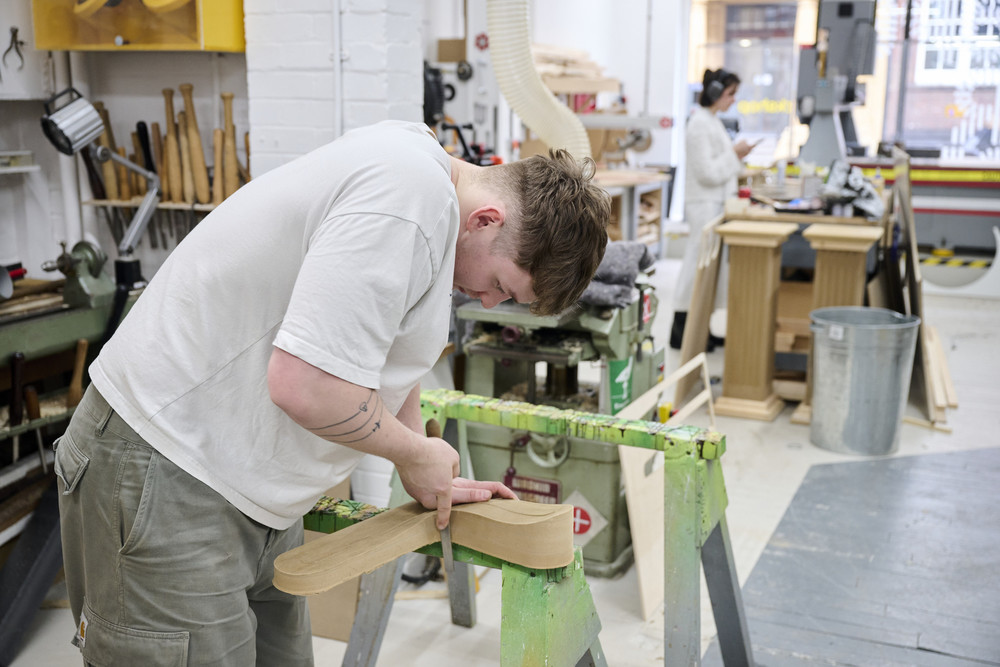
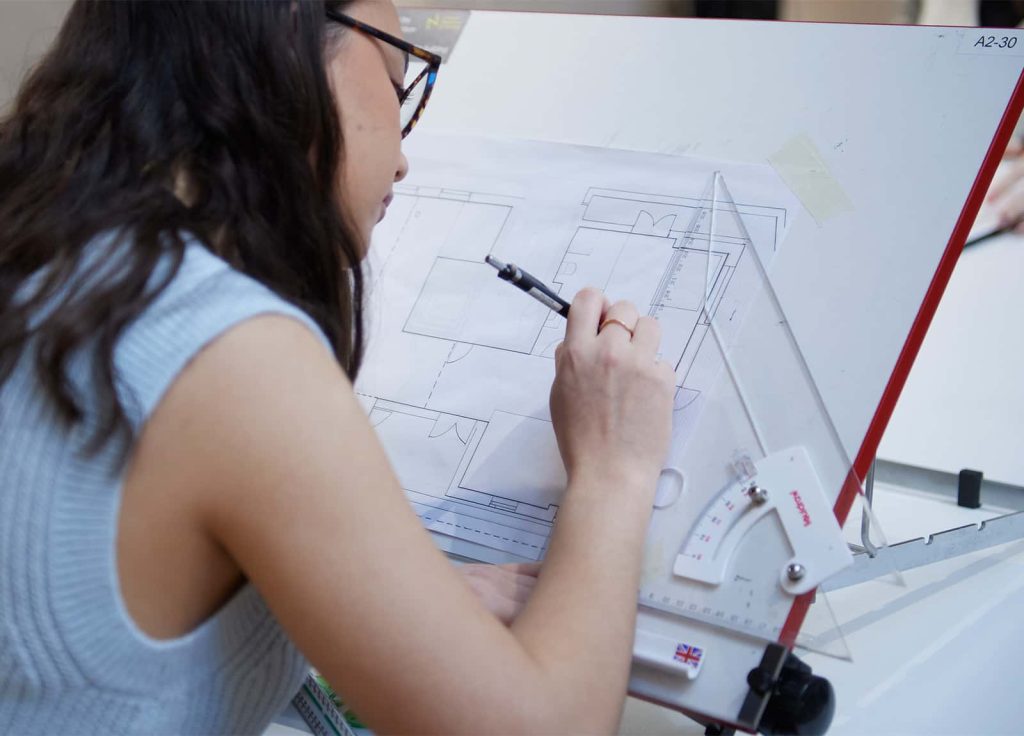
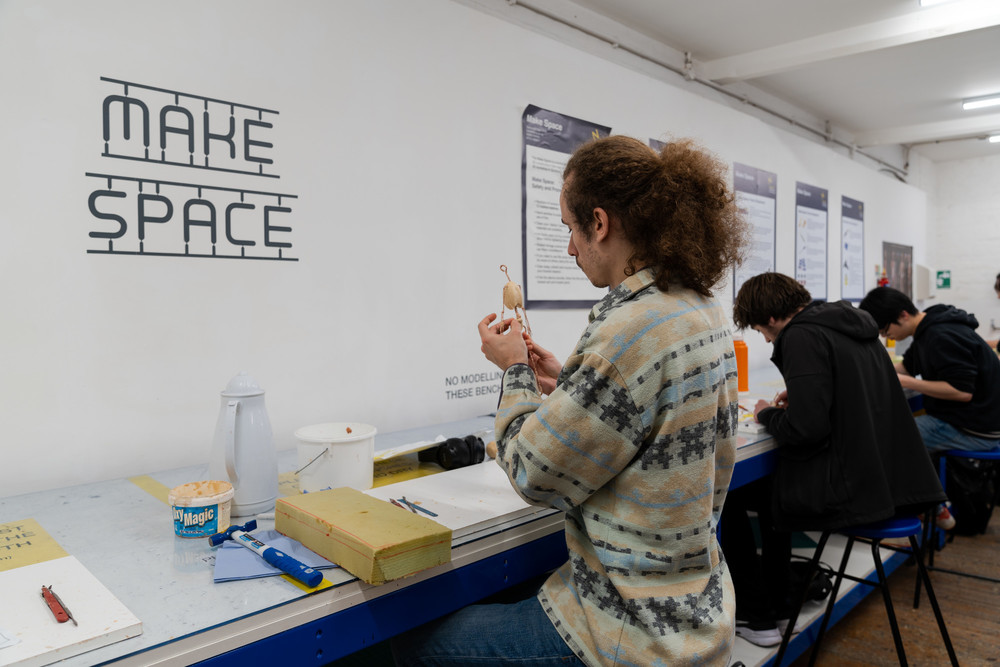
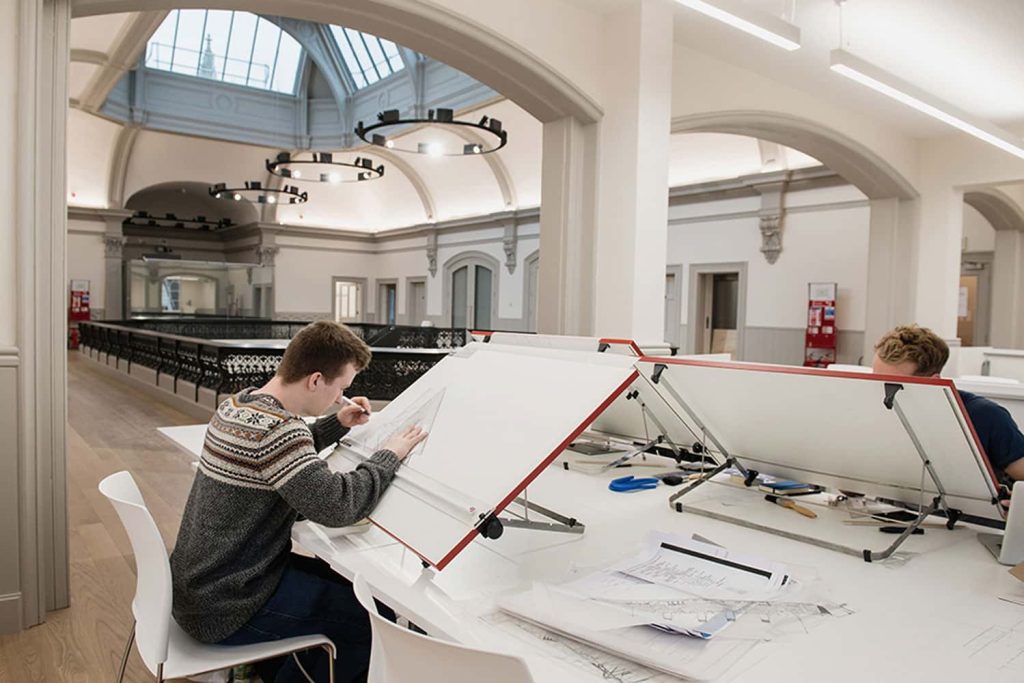
Look around our city-centre campus, and you will find studios, media labs, and creative spaces in 13 buildings that sit among the cafés, bars, independent galleries and shops of Norwich’s cultural quarter.

Typical career paths
By the end of your degree, you’ll have gained a set of transposable skills to meet or exceed the assessed benchmark requirements for ARB Part 2 qualification (Masters).
Our close links to the profession will give you the chance to meet and learn from our regional partners, including Feilden+Mawson, Purcell, LSI Architects, Hamson Barron Smith and Hudson Architects. Architecture graduates have been selected for RIBA East Awards, the TRADA University Challenge and the Design and Craftsmanship Awards.
- Architect
- Architectural assistant
- Designer
- Project manager
- Site manager
- Surveyor
- Architectural technician
- Consultant
- CAD renderer
- Product designer
- Town planner
- Architectural historian
- Conservationist
- Environmental consultant
- Architectural curator
- Model maker
- Landscape designer
- Architecture journalist
Joining the Uk Register of Architects
Under the Architects Act 1997, only those on the Architects Register are permitted to use the title of ‘Architect’ in business or practice in the UK. The current route to registration involves completion of three accredited qualifications – Part 1, Part 2, and Part 3 – and a minimum of 24 months professional experience. After completion of these components, you can register as an Architect with the Architects Registration Board (ARB) and join the Royal Institute of British Architects (RIBA) as a Chartered Architect.
In 2023, the ARB published and consulted on proposals for a new framework for the initial education and training of Architects, under the title Tomorrow’s Architects. Under the new framework, you will need to hold an ARB-accredited master’s-level qualification and an accredited practice qualification (or an accredited combined qualification) that show you have met the necessary Competency Outcomes (the threshold competencies that all architects on the Register are expected to have) and have the practice experience required to join the Register of Architects and become an Architect.
“92% of our graduates are in employment or further education within six months of graduating”
Graduate Outcomes 2021
Entry requirements
Home
Norwich University of the Arts welcomes applicants of all ages from all backgrounds.
If the qualification that you are studying is not shown, do not worry as we are able to accept other pre-entry qualifications as well as combinations of different qualifications.
Please do contact our Student Recruitment Team if you have any queries.
A/AS Levels (GCE)
GCE A/AS Levels 3 A-level qualifications at grades BBC (112 UCAS Tariff points) or above. Where candidates are not taking 3 A-levels, Norwich University of the Arts will consider combinations of A-level/AS-level and other Level 3 qualifications.
BTEC Extended Diploma (QCF or RQF)
Distinction, Merit, Merit in an art, design or media related subject
BTEC Diploma (QCF or RQF)
Distinction*, Distinction* in an art, design or media related subject
T Levels
A T Level in any subject with overall grade A* to C (Pass)
UAL Extended Diploma
Merit
UAL Level 3 Foundation Diploma in Art and Design
Pass
UAL Level 4 Foundation Diploma in Art and Design
Pass
Foundation Diploma in Art and Design
Pass
Access to Higher Education Diploma (Art and Design)
Pass
International Baccalaureate Diploma
A minimum of 26 points
Integrated foundation year (optional)
Norwich University of the Arts welcomes applicants of all ages from all backgrounds.
If the qualification that you are studying is not shown, do not worry as we are able to accept other pre-entry qualifications as well as combinations of different qualifications.
Please do contact our Student Recruitment Team if you have any queries.
A/AS Levels (GCE)
GCE A/AS Levels 2 A-level qualifications at grades CC (64 UCAS Tariff points) or above.
BTEC Extended Diploma (QCF or RQF)
Merit, Merit, Pass in an art, design or media related subject
BTEC Diploma (QCF or RQF)
Distinction*, Merit in an art, design or media related subject
T Levels
Pass (D or E on the core)
UAL Extended Diploma
Pass
UAL Level 3 Foundation Diploma in Art and Design
Pass
UAL Level 4 Foundation Diploma in Art and Design
Pass
Foundation Diploma in Art and Design
Pass
International Baccalaureate Diploma
A minimum of 26 points
Additional requirements for BA (Hons) Architecture
GCSE passes at Grade 4 or above in English, Maths, and a Science subject.
Norwich University of the Arts welcomes applicants of all ages from all backgrounds.
Your application will be primarily assessed through your portfolio (if required), responses to questions asked and personal statement, so even if you have no formal qualifications or do not meet our typical offers it can still be worth applying.
If you are studying at the time of your application and your application is successful it is likely that you will receive a conditional offer.
If the qualification that you are studying is not shown, do not worry as we are able to accept other pre-entry qualifications as well as combinations of different qualifications. Please do contact our Student Recruitment Team if you have any queries.
Fees and funding
Home
Tuition fees for the 2027/28 academic year
- Undergraduate course (three year): £10,050 per year
- Integrated Foundation Year (optional): £10,050 per year
- Level 5 Diploma Year (optional): £10,050 year
The level of fee that you will be asked to pay depends on whether you’re classed as a UK (home) or international student. Check your fee status.
Fees for subsequent years
Tuition fees may increase in subsequent years in line with inflation, subject to government regulations. The inflation rate used is expected to be the Retail Price Index excluding mortgage payments (RPIX), as forecast by the Office for Budget Responsibility. Tuition fees are reviewed annually by the University, and we would confirm any change to you in advance of each academic year.
Find our more about fees and funding
Funding your study
Depending on your circumstances, you may qualify for a bursary, scholarship or loan to help fund your study and enhance your learning experience.
International
Tuition fees for the 2027/28 academic year
- Undergraduate course (three year): £28,500
- Integrated Foundation Year (optional): £28,500
- level 5 Diploma year (optional): £28,500
The level of fee that you will be asked to pay depends on whether you’re classed as a UK (home) or international student. Check your fee status.
Fees for subsequent years
For Overseas students starting in 2027 inflation will be applied to your fees in later years. We will confirm this in advance to you of each academic year, and we will limit the increase to no more than the Office for Students’ recommended inflationary measure.
If you defer your course start date or have to extend your studies beyond the normal duration of the course the University reserves the right to charge you fees at a higher rate and/or in accordance with any legislative changes during the additional period of study.
Find our more about fees and funding
Funding your study
Please take a look at our International students page for information about fees, scholarships for international students, visas and much more.
Additional costs
Your course fees cover the cost of studies, and include loads of benefits, such as the use of our library, support from our expert employability team, access to workshops and free use of the IT equipment across our campuses. There are also other costs which you may need to consider.
Architecture BA Course Costs – (153kb)
Download PDFArchitecture BA Course Costs
(opens in a new window)
How to apply
Home
All applications for undergraduate courses will need to be made via the Universities and Colleges Admissions Service (UCAS).
You’ll need our university UCAS code (N39) as well as your course code which you’ll find on your course page.
When you register with UCAS you will need include your previous and current qualifications information, personal statement, and reference.
Once we receive your application form through UCAS, we will email confirmation that we have received it and will give you access and instructions for logging into the applicant portal. Our decision will be communicated via UCAS.
Applying for an undergraduate degreeInternational
Full-time Undergraduate International applicants can either apply via UCAS or directly by completing the online application form below or emailing the downloadable form to ioadmissions@norwichuni.ac.uk
Online Application Form (opens in a new window)
International Undergraduate Application Form – (214kb)
Download DOCXInternational Undergraduate Application Form
(opens in a new window)
Apply via UCAS
(opens in a new window)
For further support for international applicants applying for an undergraduate degree view our international pages.
-
1 / 1
Theo Galvin
Architecture BA (Hons)
1 / 2Kelsey Fordham
Architecture BA (Hons)
1 / 3Megan Petts
Architecture BA (Hons)
-
“The tutors are always there to push you further and take your project to the next level. I have noticed that tutors take the time to understand each student’s projects, allowing them to personalise their guidance and support the student’s development.”
Tracey Lin
BA (Hons) Architecture
Read Tracey’s blog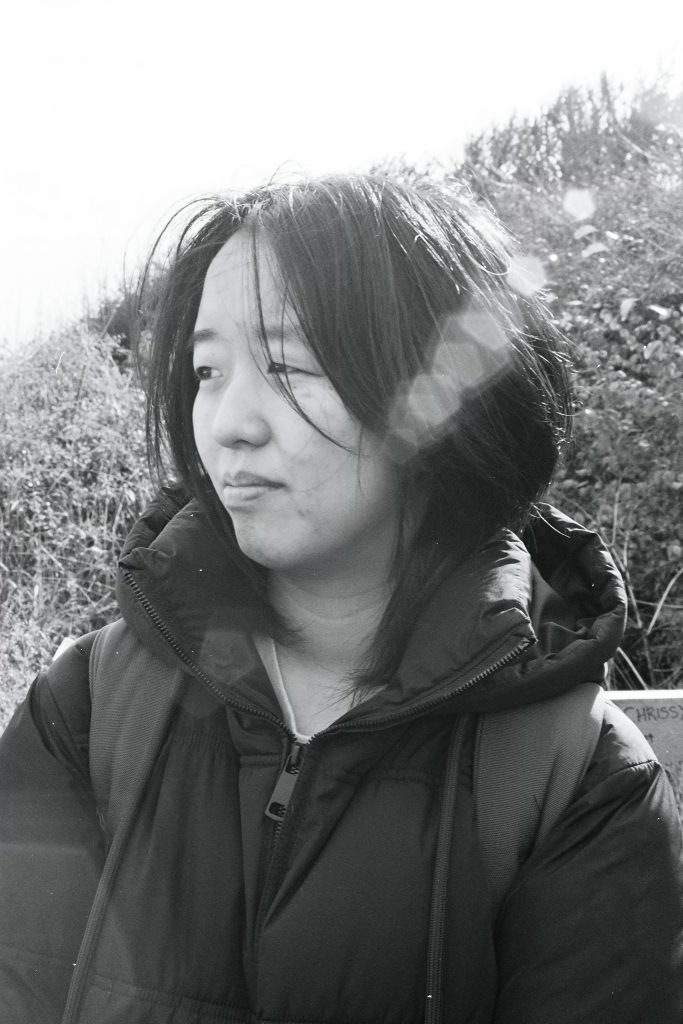
Related courses
Discover our courses and take the first step towards unleashing your potential
Showing 1-3 of 3 resultsnorwichuni_architecture
-
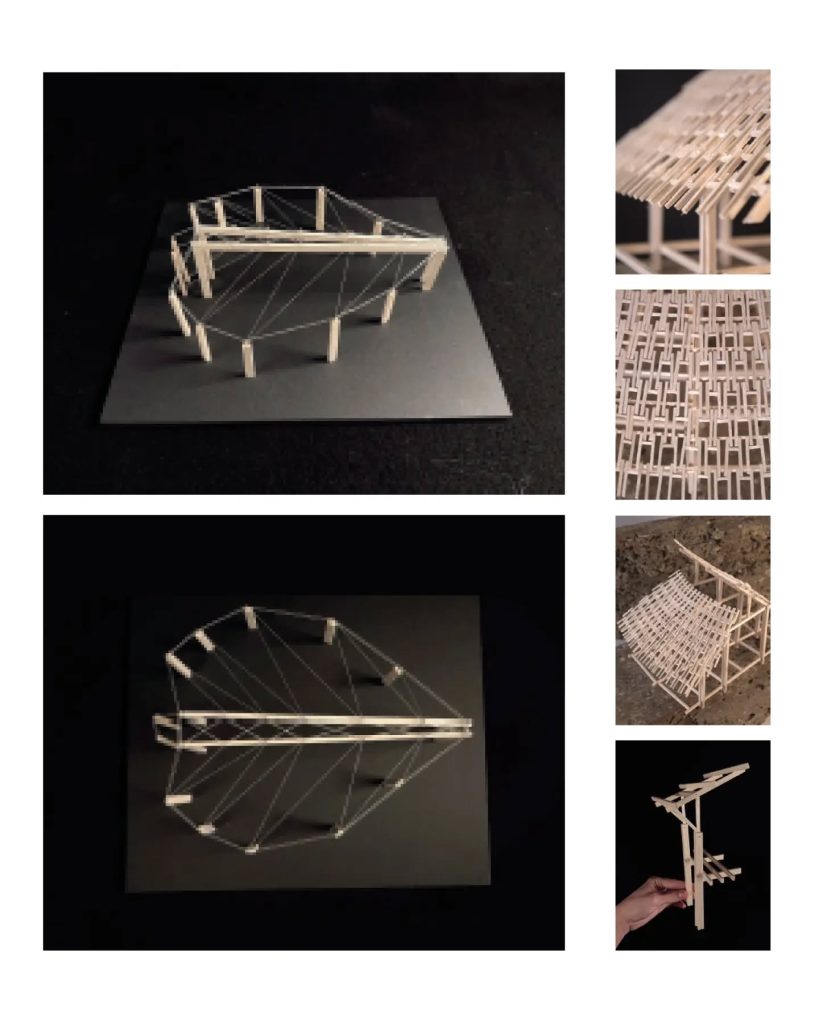
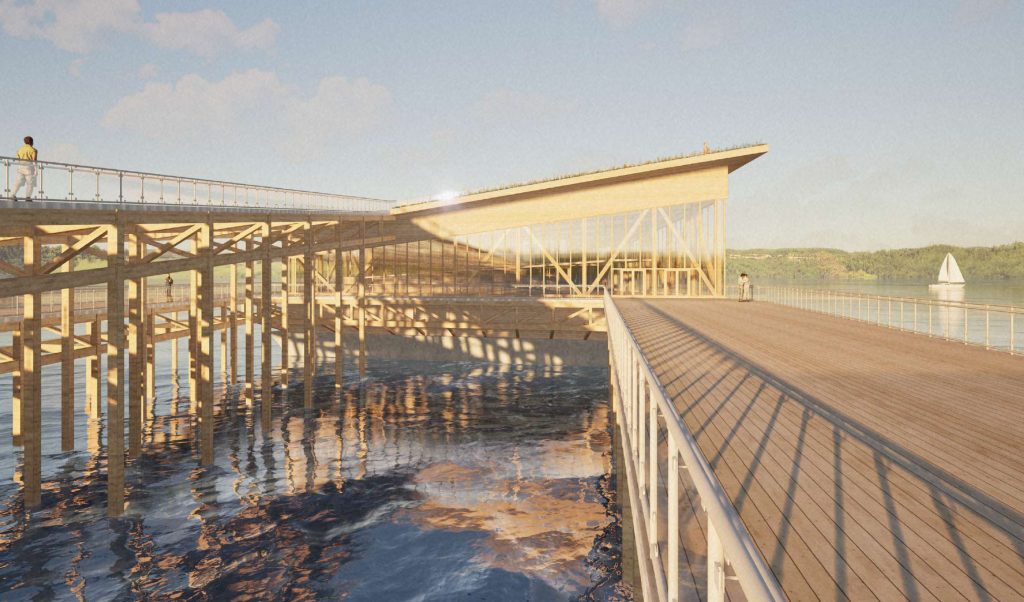
norwichuni_architecture A Second Life: Reclaiming Timber, Rebuilding Habitat by Jade Luxwolda Featured Project Year 3 2026 Situated within a coastal landscape, this project develops an architecture that supports environmental regeneration, wildlife care, and public engagement. A rehabilitation centre is combined with education and accommodation, allowing ecological processes to be observed and understood. The design is grounded in circular construction, using reclaimed harbour and sea defence timber as its primary material. This extends material lifespans while reducing environmental impact. Spaces are arranged to protect sensitive habitats while enabling access. Elevated walkways and sheltered structures mediate between visitors and landscape. A Second Life: Reclaiming Timber, Rebuilding Habitat establishes a material and ecological continuity. @jade.luxwolda Jade is also the recipient of the Hudson Award for Sustainable Design, and also received a Norwich University of the Arts Undergraduate Sustainability Award for 2026. @hudsonarchitects @norwichuni_sustainability Year 3 Tutors: William Burgess, February Phillips, Dr George Themistokleous and Romanos Tsomos #norwichuni #norwichuniarchitecture #architecture (opens in a new window)
-
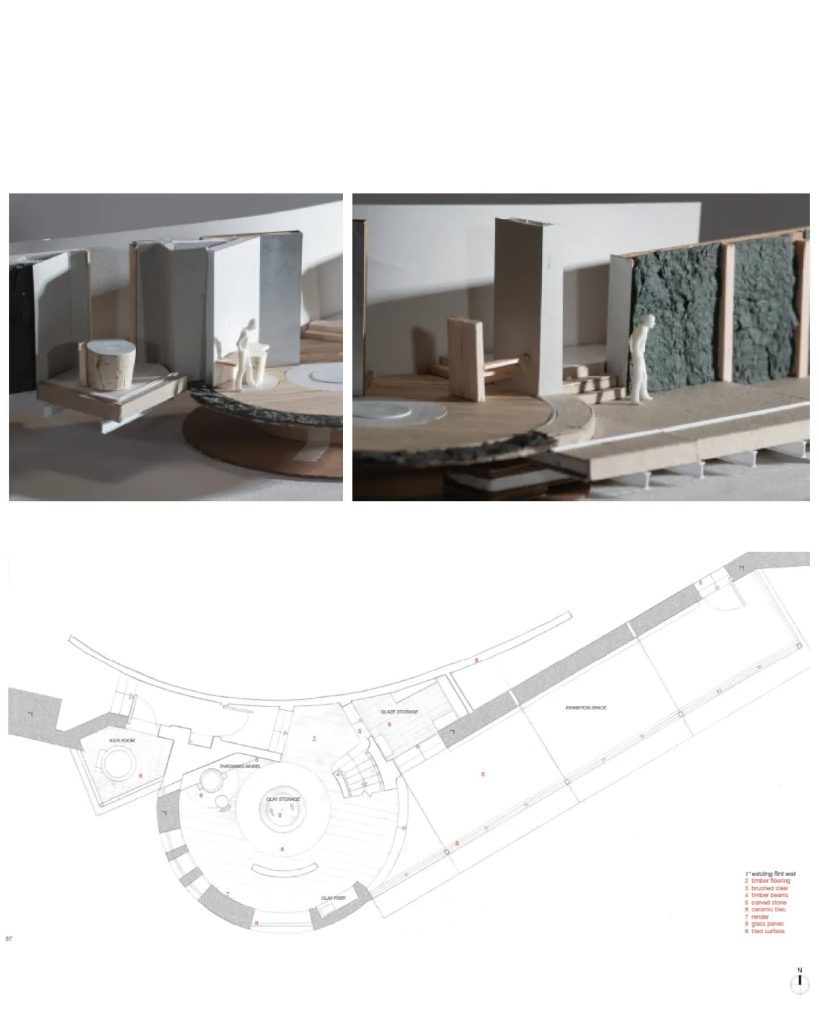
norwichuni_architecture Black Tower: Two Lives Through the Wall by Felix Brown Featured Project BA (Hons) Architecture and Interior Design Year 1 Perched on Norwich’s medieval city walls, the Black Tower is one of the largest intermediate towers along a fortification built between 1294 and 1350, its ruined fabric bearing traces of plague, riot, and fire across seven centuries. This project reimagines the tower as a shared home and workspace for a potter and a curator, negotiating the site’s dual identity as both public monument and private dwelling. Circulation responds directly to the wall’s exposed, well-trodden context, weaving separate public and private entrances around the existing path network and adjacent road. Natural light drives the design: expansive south-facing glazing and a new exhibition gallery along part of the wall serve both occupants’ light-dependent crafts. Materially, the intervention seeks to dignify the ruin rather than disguise it, inviting the potter to actively maintain and restore the tower’s historic fabric as part of daily inhabitation. @f3lixy_b Year 1 Architecture and Interior Design is taught in a shared and collaborative format, after which students continue in Year 2 within their specific selected course. Year 1 Tutors: Gabriela Jimenez, Elin Lund, John Small, Jason Wiggin, Dr Iuliana Gavril, Neal Lewis, Sarah de Villiers #norwichuni #norwichuniarchitecture #norwichuniinteriordesign #architecture (opens in a new window)
-
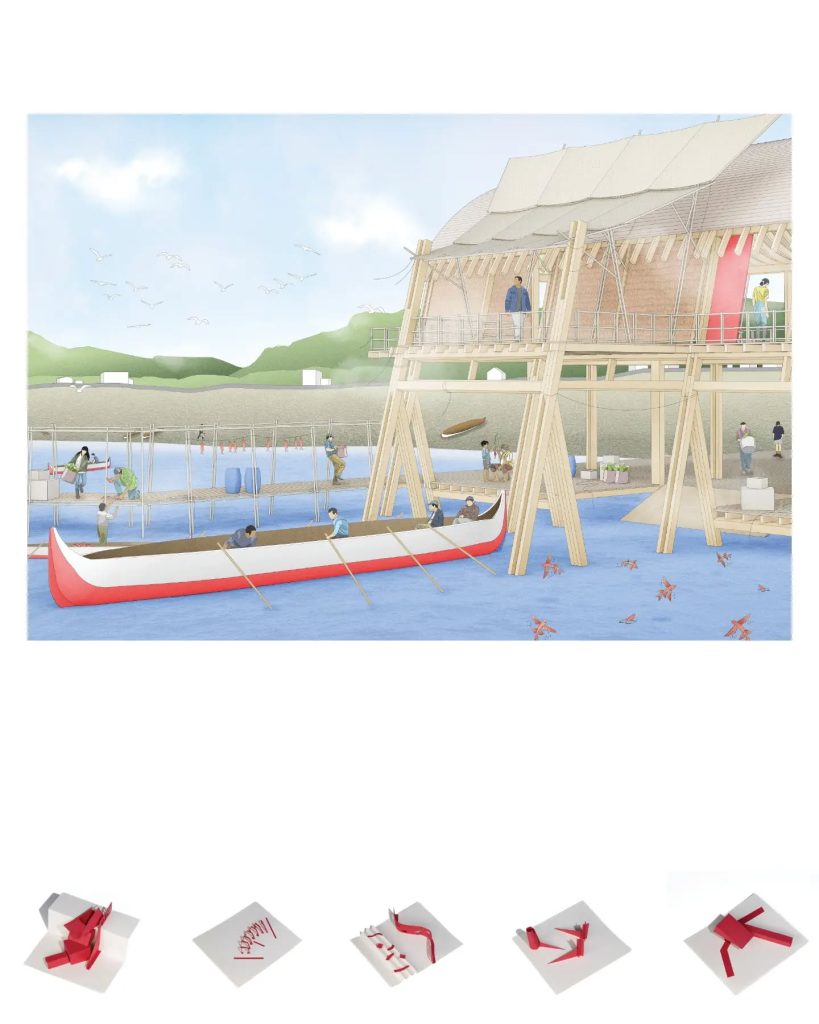
norwichuni_architecture Into and Out of Pongso no Tao by Sam Joy Featured Project MArch Y2 2026 Grounded in Tao indigenous knowledge, this project examines socio-ecological systems structured through seasonal fishing, intergenerational exchange and reciprocal spatial relations with the ocean. It reorients imposed nuclear and gasoline infrastructures through a community-scaled hybrid structure that harvests seaweed and flying-fish waste, digesting them into biogas while housing communal allocation, cooking and material-testing spaces in a semi-subterranean timber, bamboo and seaweed-based envelope. Located in Imourod, Orchid Island, the scheme aligns with routes toward the Batanes archipelago to reassert archipelagic relations and stages the voyage south again, repositioning ocean relations as the basis for Tao cultural transmission, community energy autonomy and ongoing material experimentation within local circularities. @samjoyarch Sam Joy is also the recipient of the Fielden+Mawson Architecture Award, and is the RIBA Silver President’s Medals Nominee and AJ Postgraduate Nominee for Norwich University of the Arts. MArch Tutors: Claudia Morgado, Sarah de Villiers, Tony Clelford, Dr George Themistokleous, William Hailiang Chen #norwichuni #norwichuniarchitecture (opens in a new window)
-
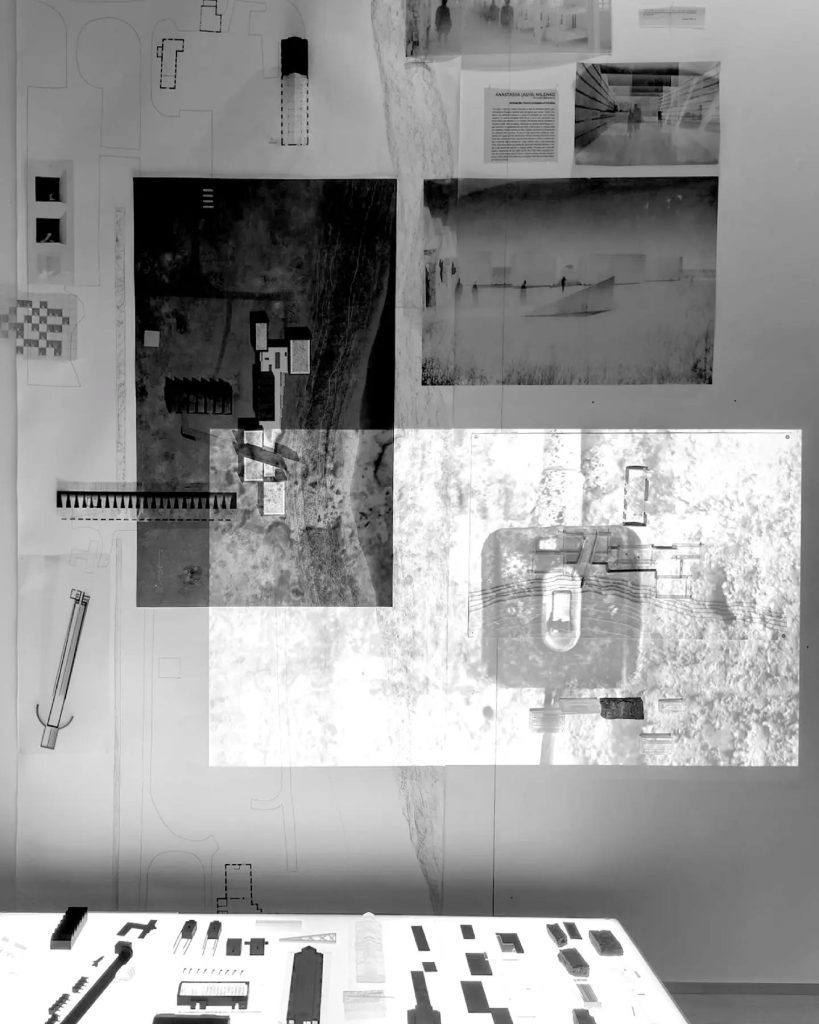
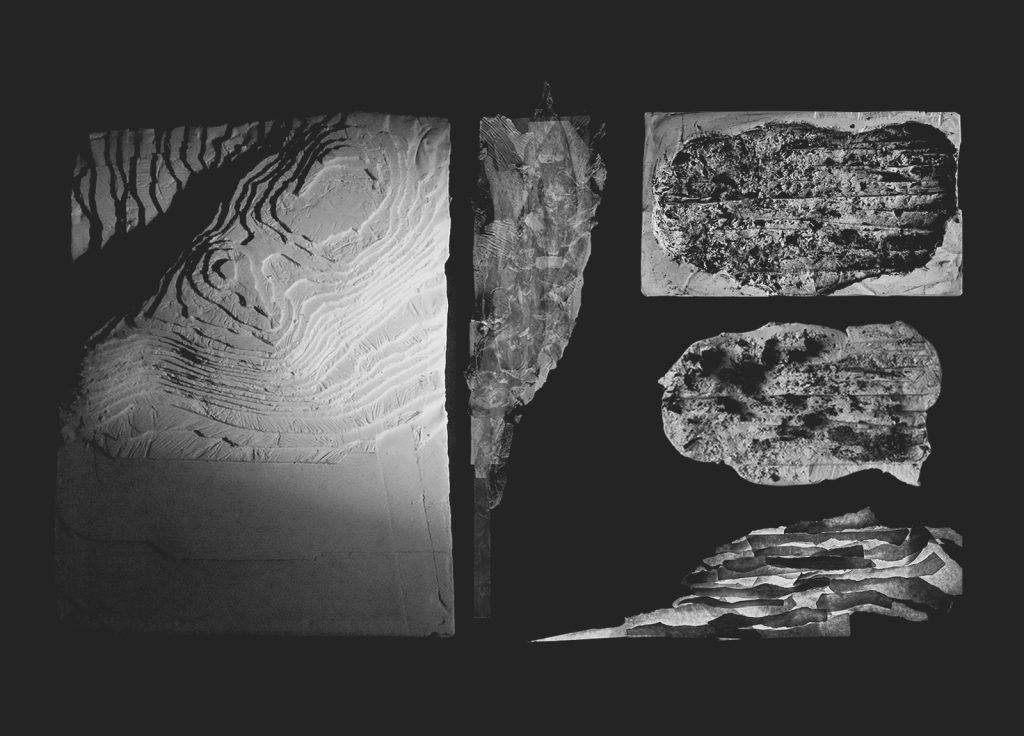
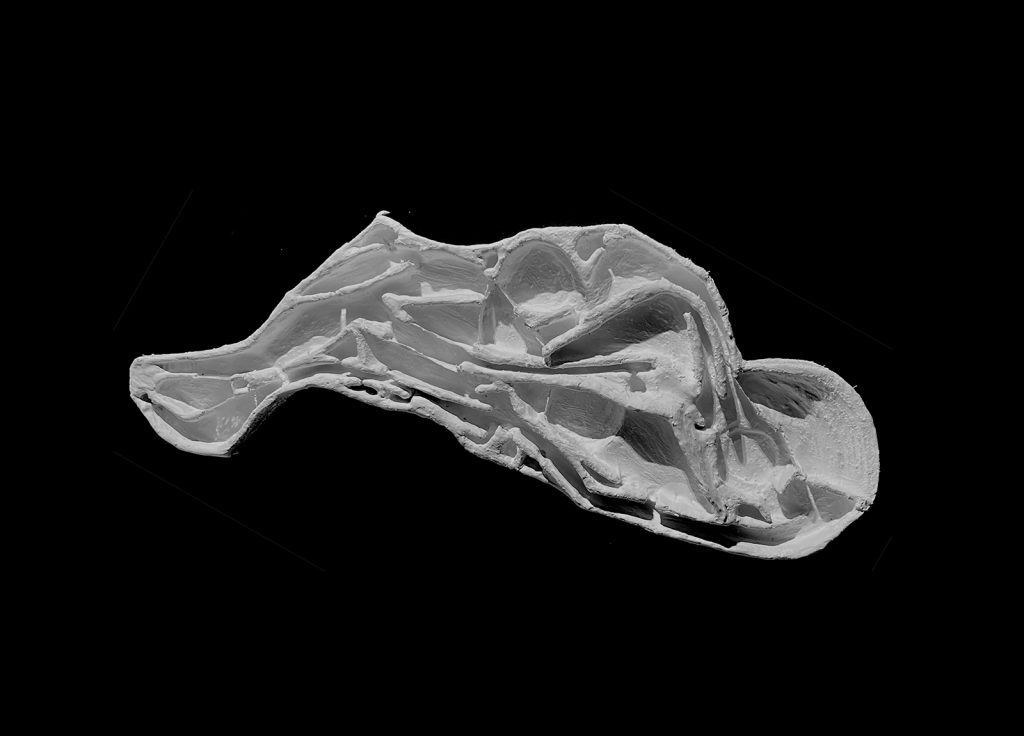
norwichuni_architecture Archiving War: Forensic Investigation of Orford Ness by Asya Milenko Featured Project Year 3, 2026 The project is driven by Forensic Architecture as both an investigative practice and a methodological framework, using architectural analysis as a medium of investigation and a tool of political resistance. The research investigates Orford Ness as a site of crime, arguing that every former military base embodies an act of violence that demands forensic examination. In response to global crises and catastrophes, the proposed design focuses on contemporary war and conflict. Creating space for archiving allows this knowledge to develop and become visible. The aim is to help prevent future conflict through collective knowledge. This archive should remain open, allowing new voices, especially those affected by conflict, to contribute over time. The project works across two registers: contemporary war and conflict, and the site of Orford Ness. It proposes an archive and counter-forensic research centre for open discussion around current conflicts. At the same time, it investigates Orford Ness as a former military site. The ecological strategy is based on the material conditions of Orford Ness, using materials found on the site. This is reflected in the use of shingle in gabion walls and peat in the rammed-earth construction. This approach follows a series of material experiments, testing different peat-based composites. This research informed the design process, exploring peat as a primary building material and responding to the site’s ecology and landscape. It creates a natural habitat for owl populations. Material from the site is a part of the archive that registers social and environmental aspects. Asya was also a recipient of the @purcell.architecture Purcell Report Award and the AJ Undergraduate Nominee for Norwich University of the Arts. @svit.lovyv Year 3 Tutors: William Burgess, February Phillips, Dr George Themistokleous and Romanos Tsomos #norwichuni #norwichuniarchitecture (opens in a new window)
-
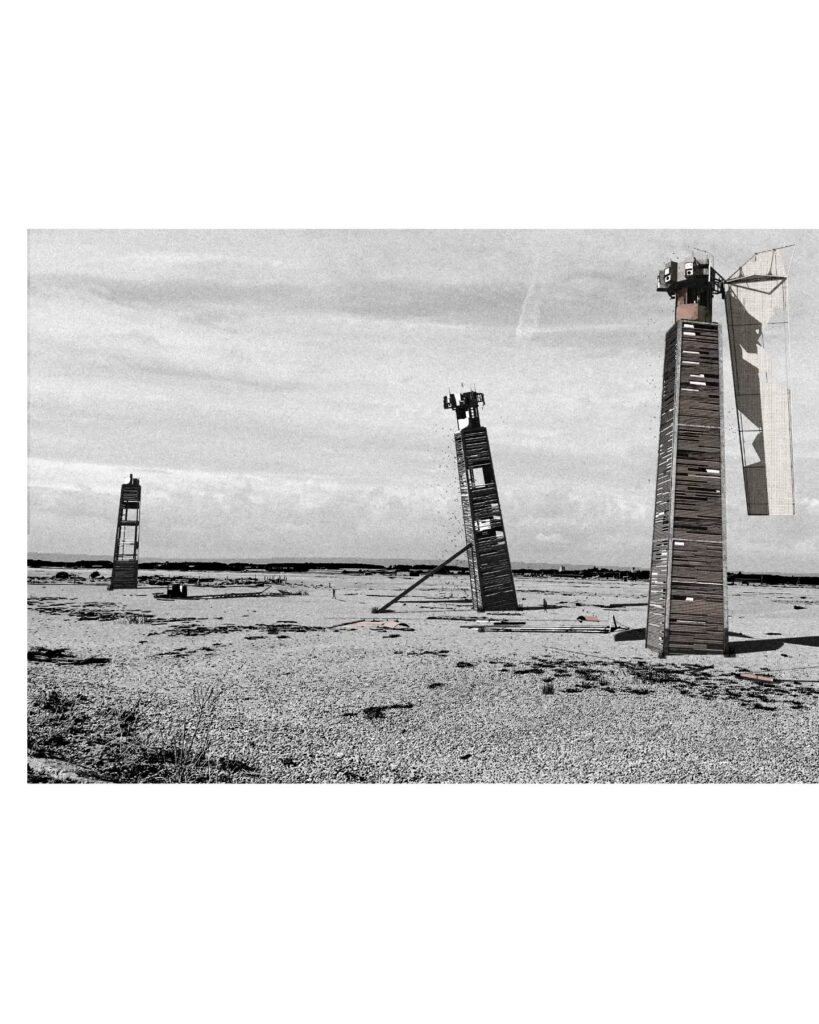
norwichuni_architecture An Archival Double by Louie Paterson Dean Featured Project BA (Hons) Architecture Year 3 2026 This project proposes an archive for the fragile landscape of Orford Ness. Drawing from Anthony Vidler’s Dark Space and W.G. Sebald’s The Rings of Saturn, the scheme explores the relationship between environmental change and how it is captured through analogue photography. Camera obscuras distributed across the site capture views determined not by human intention but by wind and changeable landscape conditions. These images are transported, developed, stored and projected by a community of archivists whose labour sustains the archive. Inspired by Louis Kahn’s distinction between ‘servant’ and ‘served’ spaces, the architecture initially privileges the visitor, concealing the archivists behind mirrored boundaries. However, in the archive storage chamber, spatial ambiguity destabilises this hierarchy. As time passes, weathered decay triggers accidental failures that disrupt the analogue apparatus. Gradually, the site itself assumes authorship over the archive, transforming the architecture into a ‘way of seeing’ through which environmental degradation overtakes the production of the image, allowing the site to determine what can be seen. @louie_p_de Recipient of the Sir Peter Cook Drawing Award and also a joint RIBA Bronze Nominee for Norwich University of the Arts for 2026. Year 3 Tutors: William Burgess, February Phillips, Dr George Themistokleous and Romanos Tsomos #norwichuni #norwichuniarchitecture (opens in a new window)
-
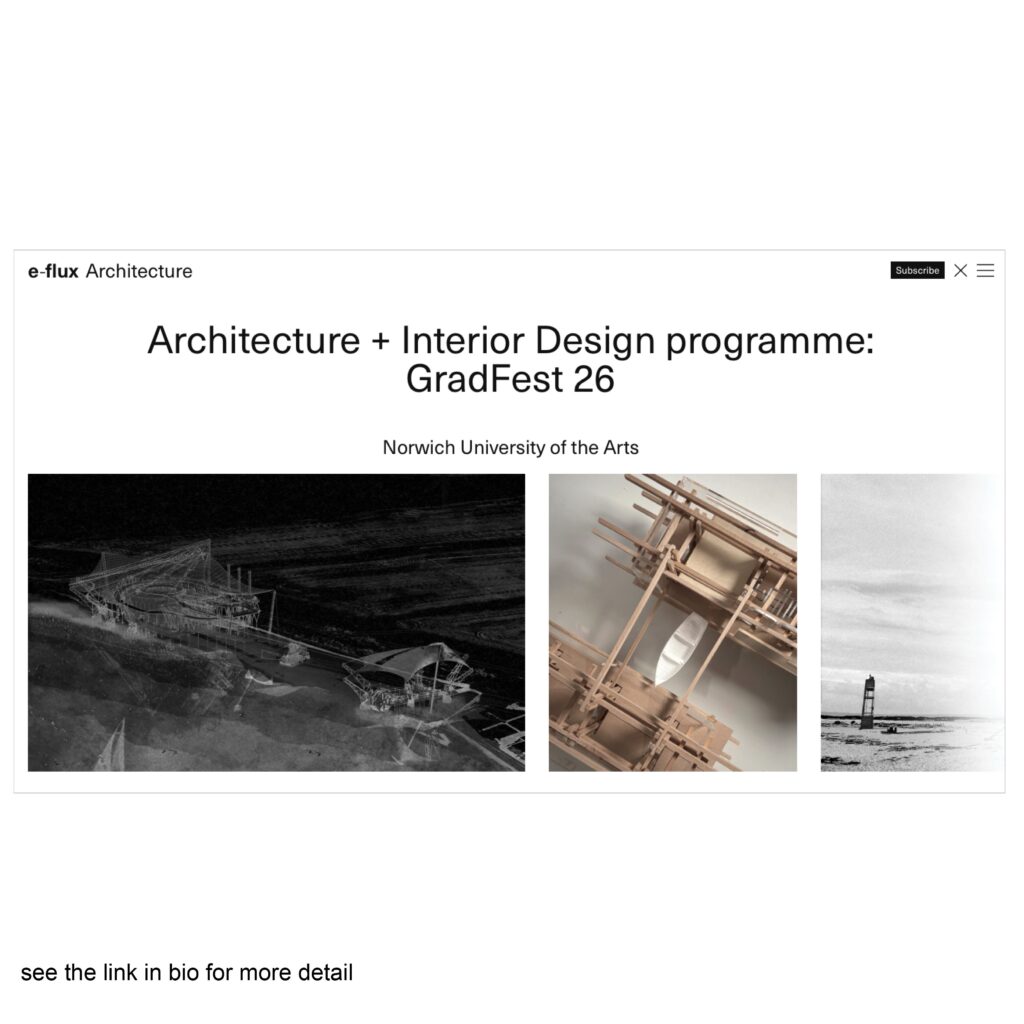
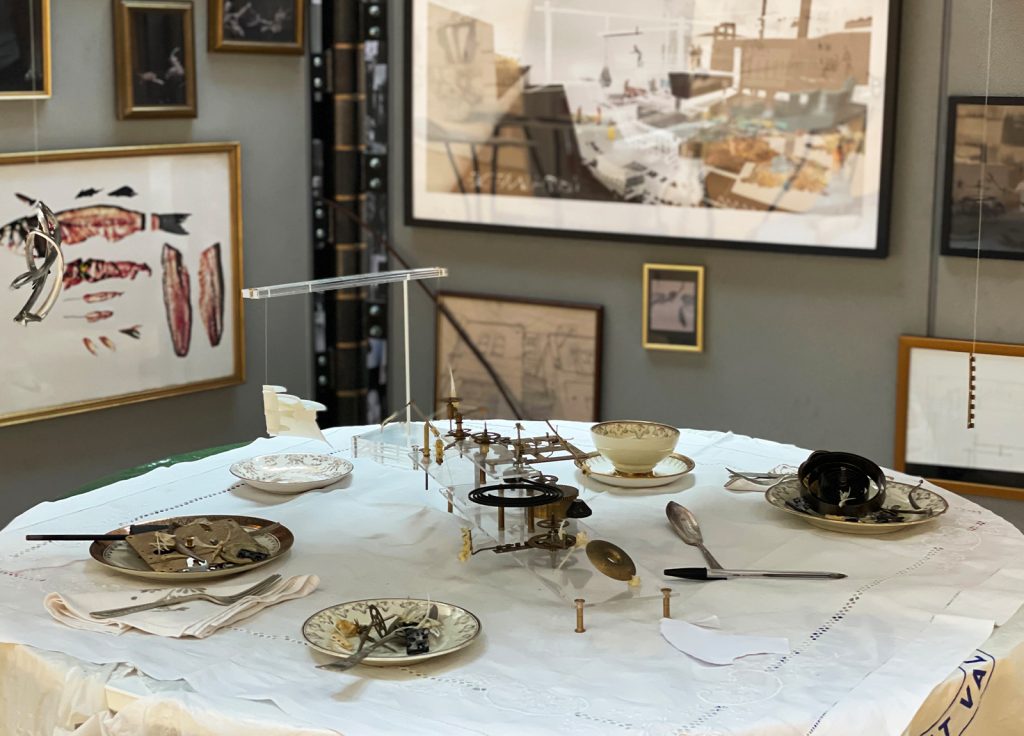
norwichuni_architecture New feature on e-flux architecture out now! The Norwich Architecture and Interior Design (A+I) Programme recently presented its annual exhibition at Boardman House, Norwich, from June 11–25, 2026. Now read in retrospect, the work brings into focus a year of site-based enquiry, material testing, and collective production. Drawings, models, films, and prototypes registered decisions, reversals, and negotiations shaped by specific spatial and environmental conditions. Read more at the link in our bio, and expanded project details coming soon in a new article to be shared early next week! #norwichuniversityofthearts #efluxarchitecture #norwichuniinteriordesign #norwichuniarchitecture (opens in a new window)
-
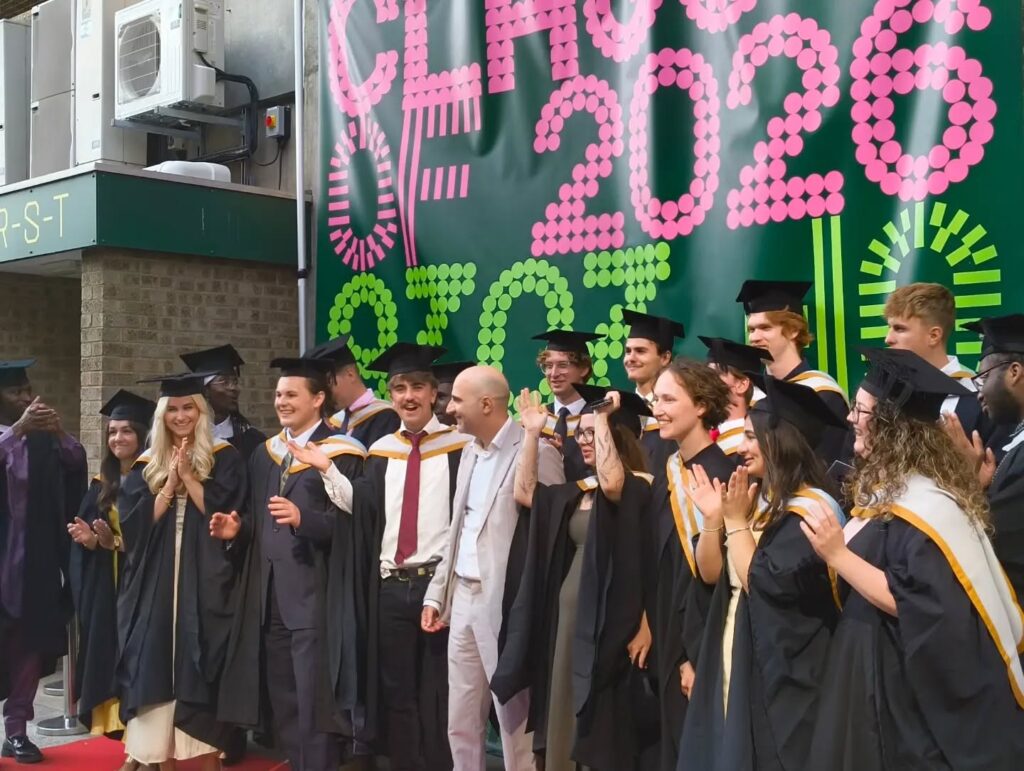
norwichuni_architecture Congratulations class of 2026 BA Hons Architecture and MArch, and all their proud family and friends! 🎉 🎉 🎉 (opens in a new window)
-

norwichuni_architecture Film from the AA Visiting School @aavs_latitudes based in Izmir, Turkey – where two @norwichuniarts BA (Hons) Architecture students, Ben Ludlam and Jakob Rode-Christoffersen have taken part. Film by @evrimkarada. (opens in a new window)
-
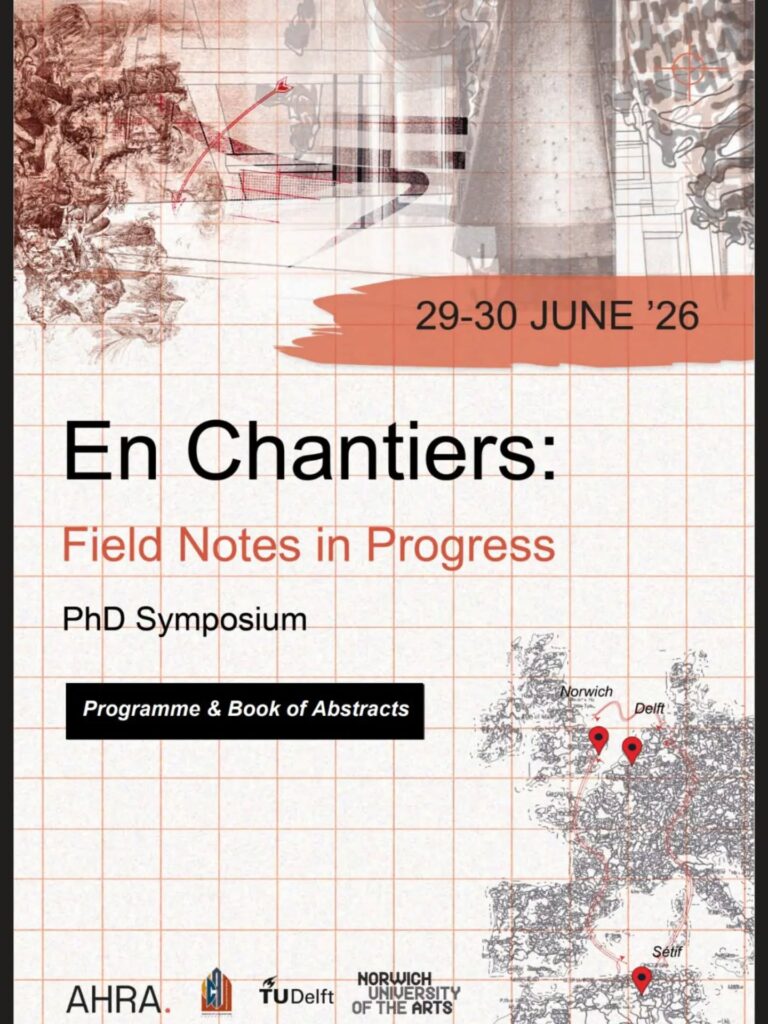
norwichuni_architecture Connecting Norwich (UK), Delft (Netherlands) and Setif (Algeria). En Chantiers: Field Notes in Progress Join us for an international symposium led by the Architectural Humanities Research Association. Monday 29 – Tuesday 30 June 2026 Peter Cook: Wonder Hub (BPR-01) 08:30-17:30 Register your interest at the link in bio. Refreshments and lunch will be provided. Research in the architectural humanities rarely moves in a straight line. It develops through fragments of observation, incomplete archives, tentative sketches, unexpected encounters, and reflections that may never make their way into a finished thesis or publication. This symposium, En Chantiers: Field Notes in Progress, foregrounds the provisional and the unfinished as productive spaces of inquiry. By placing emphasis on field notes; broadly understood as the marks, traces, and records of ongoing research, this symposium invites doctoral students to reflect on how knowledge is gathered, tested, and re-shaped in practice. Convened by the AHRA PhD Student Representatives Group: Khaoula Hannachi, Soscha Monteiro de Jesus, Megan Brien. The Norwich hub is hosted by the Architecture and Interior Design programme, Professor Teresa Stoppani and chaired by Megan Brien. (opens in a new window)
-
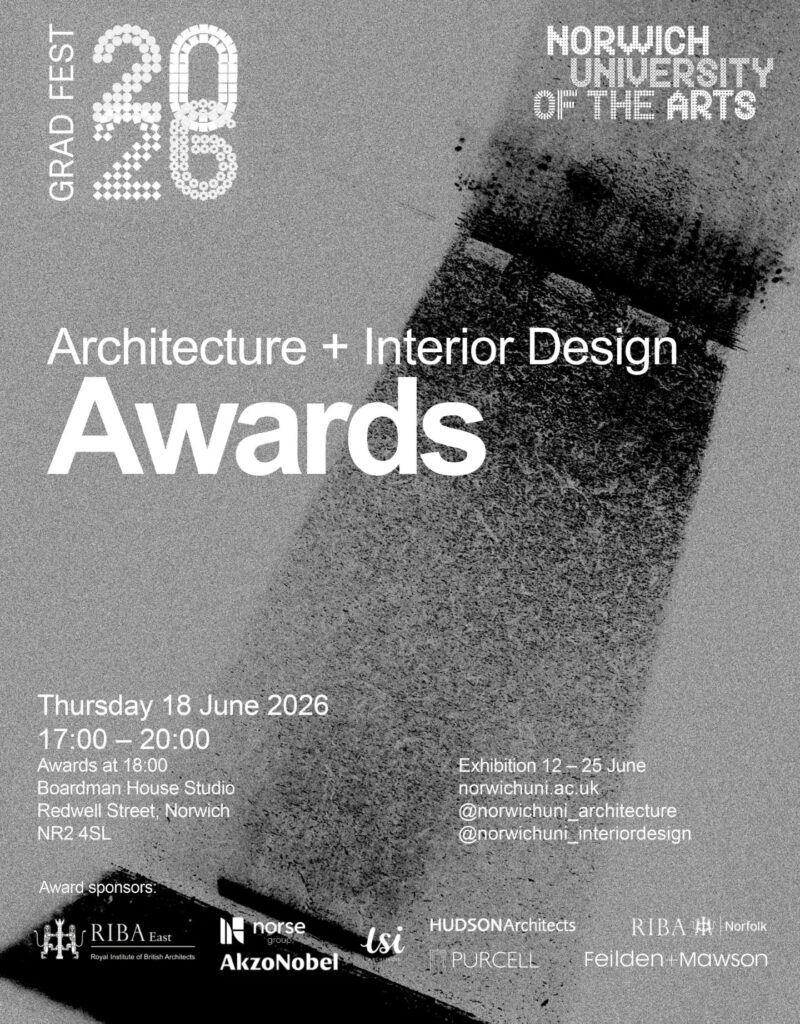
norwichuni_architecture Please join us today, Thursday 18 June 2026, 17:00-20:00 for the Architecture and Interior Design Awards at the Boardman House GradFest exhibition – Redwell Street, Norwich NR2 4SL. The exhibition documents final projects and the processes that led to them: shared and individual journeys of research, design and material experimentation, and the exploration of questions, risks taken, and professional values formed along the way that will continue to shape our graduates’ practice. This evening we will celebrate projects that have excelled in one or more aspects of spatial design, environmental care, technical resolution, sustainability, social awareness, and representation. The Awards ceremony will start at 6pm, with a keynote address by Sir Peter Cook, creator of the University’s Wonder Hub. Please join us and our award sponsors for this festive event. All welcome. Refreshments will be served. Architecture and Interior Design Programme. Norwich University of the Arts #norwichuniarts @norwichuniarts @sirpetercook @norwichuni_interiordesign @norwichuni_architecture (opens in a new window)
-
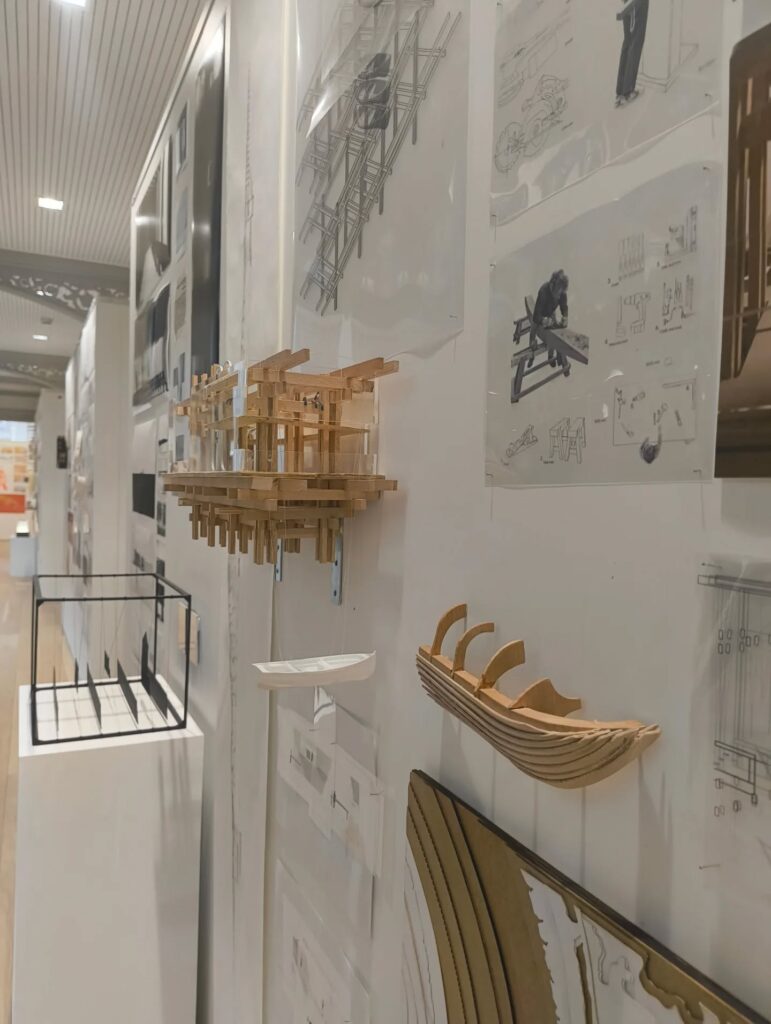
norwichuni_architecture Come and have a first view of our BA (Hons) Architecture and MArch graduating work for this year, now on through to 25 June at Boardman House, Norwich. Open 10am – 4pm, including today. See norwichuni.ac.uk for more details to plan your visit. (opens in a new window)
-

norwichuni_architecture Fantastic madness loading across every surface in Boardman House with @norwichuni_architecture and @norwichuni_interiordesign ramping up preparations for Grad Fest opening next week 🔨✂️ 💥 (opens in a new window)
-
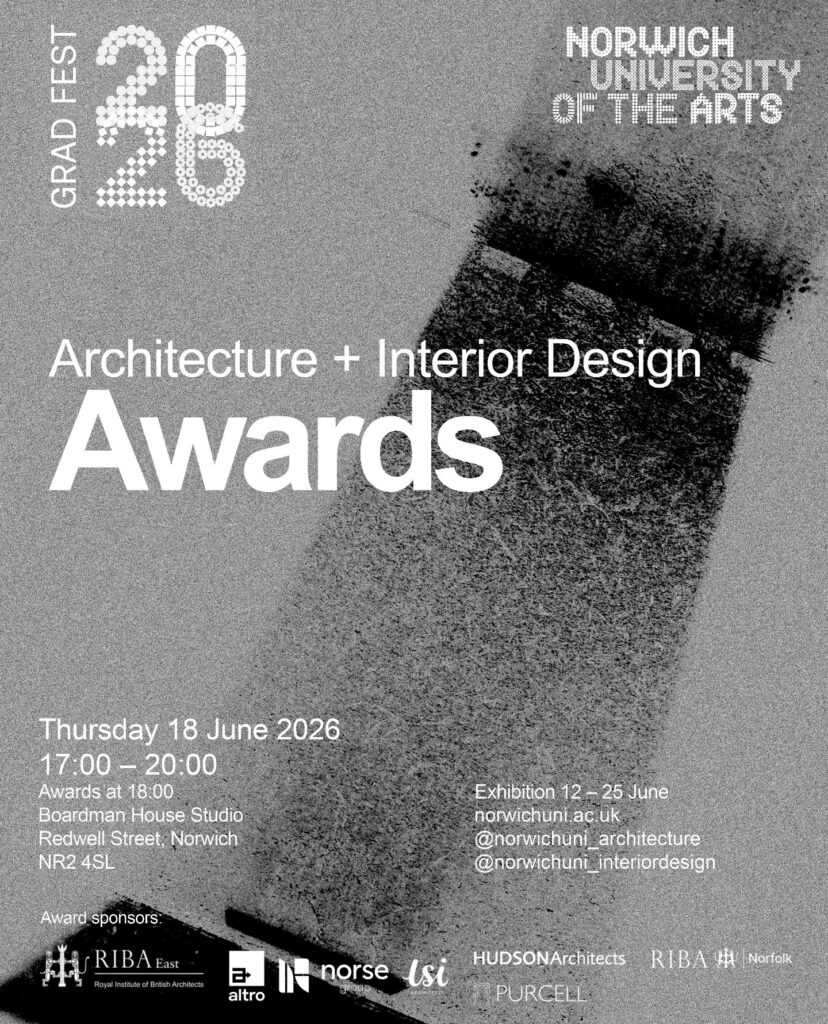
norwichuni_architecture A+ID Awards Evening Thursday 18 June 2026, 17:00–20:00 Boardman House Studio Redwell Street, Norwich NR2 4SL Exhibition of Work by Graduating Students BA(Hons) Architecture | Master of Architecture | BA(Hons) Interior Design GRAD FEST 2026 celebrates the work of Norwich University of the Arts graduating students. We are proud to present this year’s Architecture and Interior Design projects in our studios at Boardman House, in the spaces where they were developed, tested and made. The exhibition documents final projects and the processes that led to them: shared and individual journeys of research, design and material experimentation, and the exploration of questions, risks taken, and professional values formed along the way that will continue to shape our graduates’ practice. On the 18th June, with the A+ID Awards we recognise projects that have excelled in one or more aspects of spatial design, environmental care, technical resolution, sustainability, social awareness, and representation. Please join us and our award sponsors for this festive event. All welcome. Architecture and Interior Design Programme Norwich University of the Arts (opens in a new window)
-

norwichuni_architecture Join us for Grad Fest from 12 – 25 June, showing work from our graduate third year Architecture, Interior Design and MArch graduating cohort! Find us at Boardman House, Redwell Street, NR2 4SL. When you visit, also see work across our campus of all the other programmes, including Fine Art, Textiles, Games, Illustration and many more. Find out more @norwichuniarts. (opens in a new window)
-
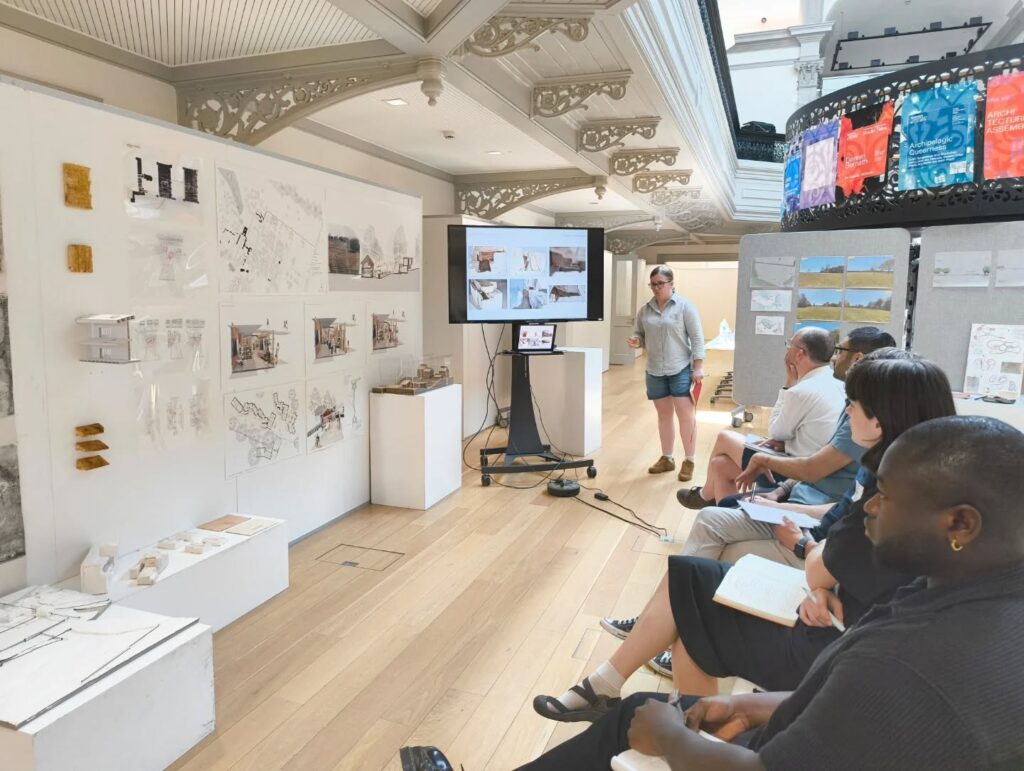
norwichuni_architecture Some moments from yesterday’s MArch reviews at Boardman House. Thank you to the fabulous critics panel that joined us: Ioana Man (AA), Dominiq Oti, Joe Player (Another Kind Architects), Matthew Butters and Nimit Raval (Pascall + Watson), and Prof Dr Teresa Stoppani (Norwich University of the Arts). Our Masters Year 2 students are exploring ‘Strange Islands’, each developing a thesis project that takes the island as a testing ground for architecture, examining conditions of separation, connection, and exchange across sites, working across scales to explore how material assemblies, environmental systems, and construction strategies respond to these shifting, relational contexts. Our MArch Year 1 students explore ‘Living Blickling’, designing a cooperative housing and production community, testing modes for collective living, productive landscapes, and bio-based construction, with particular attention to material processes, environmental conditions, and long-term adaptability. It also takes on land politics of the estate typology, and considerations of commoning across materials, ecology and people. @norwichuniarts @anotherkindarchitects @pascallwatson @dominiqoti @ioana_man #norwichuniversityofthearts (opens in a new window)
-
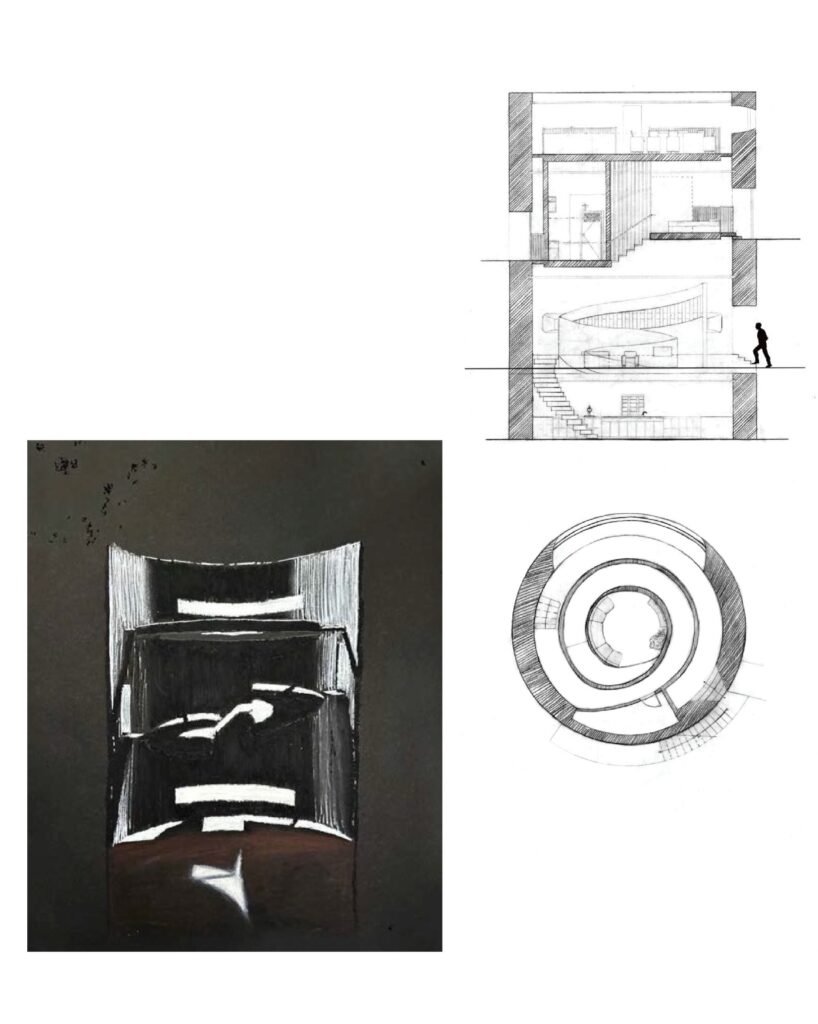
norwichuni_architecture BA Hons Architecture and Interior Design Year 1 final reviews took place this last week at Boardman House, and our students are now working hard on their final submissions! Our group has been studying and working imaginatively within four historic structures in Norwich including Cow Tower, Black Tower, St Benedict’s ruin and Peafield Mill. Thank you to our critics who joined us: Dr Tania Lopez Winkler and Lucas Reiz from superMATTERS (RCA) Ioana Man (AA) Christian Peterson (Norwich University) Images of student work featured: Eleanor Lewton Alise Lazdina Andrew Reuter Josephine Willis Divina Light Johnson Emilija Vitkeviciute Lucy Beck Katelyn Sharman Millie Paige Felix Brown Steven Palmer Helen Jarman Cameron Gillies Tutors: Elin Lund, John Small, Gabriela Jimenez, Jason Wiggin, Neil Lewis, Dr Iuliana Gavril and Sarah de Villiers. Thank you to the amazing technician team at the 3D Workshop who have helped in the making material prototypes with many of our students: James Burkill, Jim Castle and Stephen Bassett; and also to our BH technicians William McMorris, Adam Krupa and Peter Wogan. We also thank the A+ID students, especially those in third year, who have been so generous in holding a brilliant studio culture, and sharing such super guidance and encouragement to our Y1s. @norwichuniarts @norwichuni_interiordesign @norwichuni_architecture @norwichuni_3dworkshop (opens in a new window)
1 / 1 -